


Execution That Protects Your Lining
Why Refractory Dry Out Services Matter
Refractory dry out services are the final step before a lining goes into service — and one of the most common causes of premature failure is getting it wrong. Cracking, spalling, and delamination can happen on the very first firing if moisture is driven out too fast. Gulf Coast Combustion has been performing refractory dry outs since 2014 using high-velocity gas combustion systems built for precise heat-up rate and temperature control. We don’t guess at the schedule. We build it from the refractory specs, execute it clean, and document every step.
Technical Resource
The Complete Guide to Refractory Dry Out
Everything you need to know about refractory dry out — what it is, how the schedule is built, full vs. partial dry outs, steam events, and what to expect from a contractor who gets it right.
Talk to the Owner Directly
James Benefield
Owner, Gulf Coast Combustion
Call or text — James answers personally. No receptionist, no call queue, no waiting on a callback from someone who wasn’t on the last job.
What Happens When You Call
Every dry out job follows the same process. No surprises, no shortcuts.
You tell us about the job
Refractory type, lining thickness, equipment type, and timeline. James talks through the scope directly — no middleman, no guesswork.
We build the execution plan
Temperature targets, ramp rates, hold times, and thermocouple placement — all defined in writing from the manufacturer’s data sheet before we ever show up on site.
We execute the dry out on site
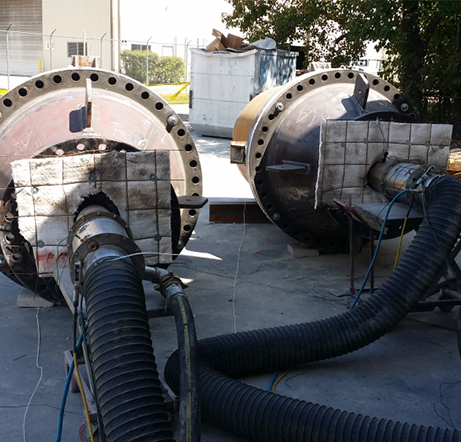
High-velocity gas combustion equipment, calibrated chart recorders running from ambient through cool-down, and a technician on site for the full cycle. Steam events are handled per the plan — no shortcuts.
You get the documentation before we leave
Strip chart recorder trace, calibration certificate, and heat treatment report signed off by the lead technician. The job folder leaves the site with you. Every time.
Partial and Full Refractory Dry Outs
We perform both partial and full dry outs. A full dry out drives all moisture — free water and chemically bound water — out of the lining completely. It is required for new equipment commissioning and complete relinings. A partial dry out brings the refractory to a defined intermediate point, used when the equipment needs to return to service before a full cure window is available. Both are executed per the refractory manufacturer’s recommendations and customer specifications.
Equipment We Dry Out On-Site
Gulf Coast Combustion works on a wide range of equipment including convection boxes, heater boxes, stacks, ducts, large valves, casts and molds, package boilers, process heaters, and furnaces. If it has refractory, we can dry it out.
Every Job Gets an Execution Plan
Before we show up on site, we build a job-specific execution plan. Temperature targets, ramp rates, hold times, and thermocouple placement are all defined in advance based on the refractory type, lining thickness, and application. Refractory can range from 1″ to 15″ thick — the schedule changes accordingly.
If steam appears at any hold stage during the dry out, the process stops and holds at that temperature until the steam is completely gone. That’s not a judgment call. It’s a required part of proper execution, and it’s documented in the job record. For a closer look at what happens when a dry out schedule gets compressed, read What Happens If You Rush a Refractory Dry Out.
Documentation on Every Job
Every dry out includes a complete documentation package: chart recorder trace covering every hold stage and temperature ramp, calibration certificate, and heat treatment report signed off at job completion. You have a permanent record that the schedule was followed correctly before we leave the site.
Process Start Ups
Gulf Coast Combustion also offers process start ups. Our high-velocity combustion systems allow operators to vary heat output precisely, bringing boilers, heaters, and other equipment up and online in a controlled, timely manner.
Frequently Asked Questions
How quickly can GCC mobilize to a job?+
If we’re available, we can mobilize immediately or next day if schedule allows. Call 713-425-3773 or text James at 832-797-3428 to check availability.
What equipment do you dry out?+
Convection boxes, heater boxes, stacks, ducts, large industrial valves, casts, molds, package boilers, process heaters, and furnaces. If it has refractory, we can dry it out.
Do you perform both full and partial dry outs?+
Yes. A full dry out is required for new installations and complete relinings. A partial dry out is used when equipment needs to return to service before a full cure window is available. Both are executed per the manufacturer’s specifications.
How long does a refractory dry out take?+
It depends on wall thickness, refractory type, and the manufacturer’s schedule. Heat-up rate, soak time, and cool-down all follow the spec requirements — there’s no shortcut on any of it. Most jobs run 1–3 days depending on lining thickness and equipment size. See the full timeline breakdown.
What areas do you serve?+
Gulf Coast Combustion is based in Spring, TX and serves the Gulf Coast industrial corridor, Texas, Louisiana, and nationwide. View all service areas.
Serving the Gulf Coast. Available Nationwide.
Ready to Schedule Your Next Refractory Dry Out?
Call or text James directly at 832-797-3428 — or reach the office at 713-425-3773.
Email: james@gulfcoastcombustion.com
View all heat treating services including pressure vessel PWHT, localized PWHT, consulting, and more.
