Understanding the Method Behind Gulf Coast Combustion’s On-Site PWHT Process
When people hear “heat treating,” they often picture a box furnace or electric resistance elements. Gulf Coast Combustion specializes in something different: direct gas fire heat treating for high-pressure vessels using high-velocity combustion. It’s worth understanding what that means and why it produces excellent results for pressure vessel applications.

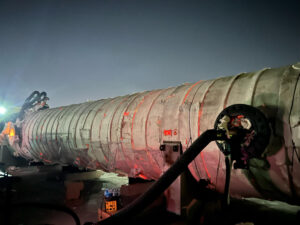
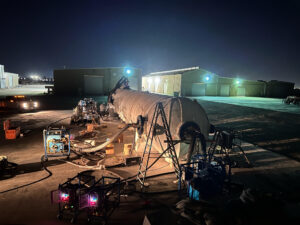
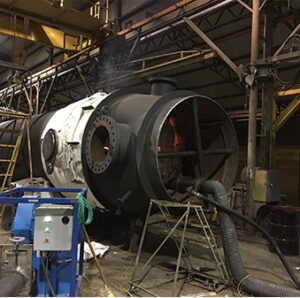
In direct gas fire heat treating, we use natural gas-fired burners — what the industry calls a gas train setup — to produce a high-velocity flame that’s directed at the vessel or component being treated. The burners are positioned and tuned to achieve even heat distribution across the entire vessel. A network of thermocouples monitors temperature at multiple points simultaneously, and automated controls adjust the heat output to maintain the target temperature profile.
The key advantage of high-velocity combustion is heat transfer efficiency and uniformity. Unlike electric resistance elements, which heat primarily by radiation, high-velocity gas burners produce both convective and radiant heat transfer — which means faster heat-up rates and more even temperature distribution across the vessel surface. This is especially important for large, high-pressure, thick-walled vessels where temperature gradients between the top and bottom, or the center and the ends, can be a real challenge.
For fabricators building custom-engineered pressure vessels for oil & gas, chemical processing, or renewable energy applications, temperature uniformity across the full wall thickness isn’t just a preference — it’s a code requirement. ASME Section VIII specifies that the entire weld and heat affected zone must reach the required temperature, not just the surface. Direct gas fire’s combination of convective and radiant heat transfer is particularly effective at driving heat through thick-walled material to achieve that result.
Direct gas fire is also highly scalable. We can rig multiple burner units on a single large vessel, dial in the heat output to achieve the code-required heat-up rate, and hold the temperature precisely within the specified range. Our 6 to 8 Million BTU burners and 20 HP high-velocity blowers are built for industrial-scale work — the kind of large, custom vessels that simply can’t be moved to an outside furnace without significant cost and risk.
The other advantage worth noting is efficiency. Direct gas fire heat treating uses your facility’s natural gas supply or our supplied propane — which means faster heat-up times and lower fuel cost compared to electric resistance methods. For fabricators who are already paying close attention to project costs, that efficiency matters.
We’ve been using this method since Gulf Coast Combustion was founded in 2013. In that time, we’ve heat treated more pressure vessels on-site per year than any other mobile heat treating company in the United States. Over 95% of our work is direct gas fire — it’s not one method among many for us, it’s what we do. If you want to see it in action, we have a time-lapse video on our website showing a complete PWHT cycle from start to finish.
Need direct gas fire PWHT for your next high-pressure vessel project? Call Gulf Coast Combustion at 713-425-3773 or visit gulfcoastcombustion.com to request a quote.