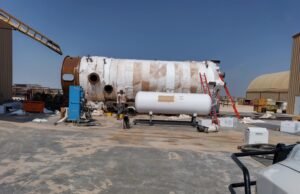

If you fabricate pressure vessels, post weld heat treatment (PWHT) isn’t optional — it’s a code requirement driven by ASME Section VIII, Division 1. But understanding exactly when it’s required, and what the parameters look like, is where things can get complicated. Here’s a practical breakdown.
Gulf Coast Combustion has been executing ASME-compliant pressure vessel PWHT via direct gas fire combustion since 2014. Every job includes full documentation before the crew leaves the yard. Here’s the short version — what PWHT is, who needs it, when it’s required, where it happens, and why it matters:
Talk to the Owner Directly
Owner, Gulf Coast Combustion
Call or text — James answers personally
No receptionist. No call queue. No waiting on a callback from someone who wasn’t on the last job.
Quick Reference
| What | Post weld heat treatment (PWHT) is the controlled heating and cooling of a pressure vessel after welding to relieve residual stresses in the steel and weld heat affected zone. |
| Who | Required for fabricators building carbon steel pressure vessels to ASME Section VIII Division 1 when wall thickness, material type, or service conditions trigger the requirement under UCS-56. |
| When | After welding is complete, before the vessel enters service. PWHT is code-required — not discretionary. Many oil & gas and petrochemical clients specify requirements tighter than ASME minimums. |
| Where | On-site at your facility using direct gas fire combustion — no transport, no heavy haul, no furnace required. Gulf Coast Combustion mobilizes anywhere in the U.S. for vessels from 10 feet to 120 feet and beyond. |
| Why | Welding locks residual stress into the steel. In high-pressure, thick-walled vessels, those stresses can cause stress corrosion cracking and compromise weld integrity over time. PWHT relieves them — with full documentation proving the process was performed to code. |
Technical Resource
The Fabricator’s Complete Guide to Pressure Vessel PWHT
Everything you need to know about on-site pressure vessel PWHT — code requirements, execution standards, thermocouple methodology, documentation, and how to evaluate a heat treating contractor.
When PWHT Is Required Under ASME Section VIII
ASME Section VIII mandates PWHT based on a combination of factors: the thickness of the weld, the service conditions, and any supplemental requirements from the Welding Procedure Specification (WPS). For carbon steel pressure vessels, PWHT is generally required when the nominal thickness exceeds 1.5 inches — but that threshold drops for materials with higher carbon equivalents or for vessels destined for lethal service.
| Trigger Factor | Condition | PWHT Required? |
|---|---|---|
| Wall thickness (carbon steel) | Nominal thickness exceeds 1.5″ | Yes |
| Lethal service | Vessel handles lethal substances | Yes — regardless of thickness |
| High temperature service | Specific high temp operating conditions | Yes — additional requirements apply |
| High carbon equivalent material | Carbon equivalent exceeds code threshold | Yes — lower thickness threshold |
| Client/WPS specification | Customer specifies PWHT in WPS or contract | Yes — regardless of code minimums |
| Corrosive service | Specific corrosive environments | Yes — stress corrosion cracking risk |
Temperature and Hold Time Requirements
The hold temperature and time at temperature are specified by the code. For carbon steel pressure vessels, the required temperature range is 1,100°F to 1,200°F, with hold time calculated based on thickness — one hour per inch for the first two inches, then 15 minutes per inch for each additional inch, with a one-hour minimum.
Getting this right matters: too low and you don’t achieve the stress relief; too high and you risk degrading the material properties you worked to achieve. Gulf Coast Combustion’s standard is 1,150°F ±50°F — held precisely, monitored continuously, and documented in full.
ASME Section VIII (UCS-56) — GCC Standard Parameters
By the Numbers
1,150°F
GCC Standard Soak Temp ±50°F
400°F/hr
Max Heat-Up Rate ÷ Wall Thickness
500°F/hr
Max Cool-Down Rate ÷ Wall Thickness
100°F
Max Temp Differential During Soak
250°F
Max Differential During Heat-Up & Cooldown
300°F
Monitoring Begins
800°F
Free Air Cooling Below
| Wall Thickness | Minimum Hold Time | Calculation |
|---|---|---|
| Up to 1″ | 1 hour minimum | Minimum regardless of thickness |
| 1″ | 1 hour | 1 hr/inch |
| 2″ | 2 hours | 1 hr/inch |
| 3″ | 2 hours 15 minutes | 2 hrs + 15 min for 3rd inch |
| 4″ | 2 hours 30 minutes | 2 hrs + 15 min each additional inch |
| 5″ | 2 hours 45 minutes | 2 hrs + 15 min each additional inch |
On-Site PWHT Pricing
See What Your Job Costs — Instantly.
Enter your vessel specs and get a budgetary estimate in seconds — built from GCC’s actual job data. No email required.
As Featured In
The Fabricator — North America’s Leading Metal Fabricating Publication
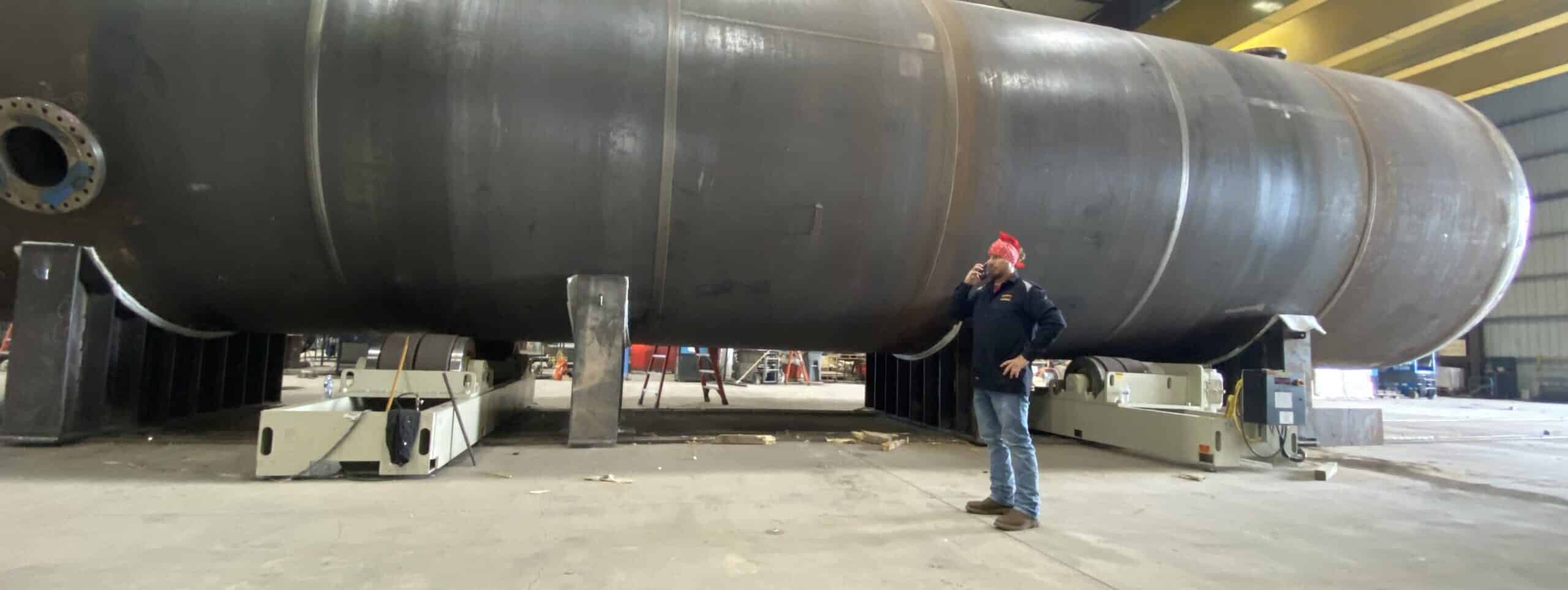
James Benefield wrote the August 2026 feature on heat treating large pressure vessels where they sit. Four PWHT methods, what actually happens inside the steel, and the point where a furnace stops being an option.
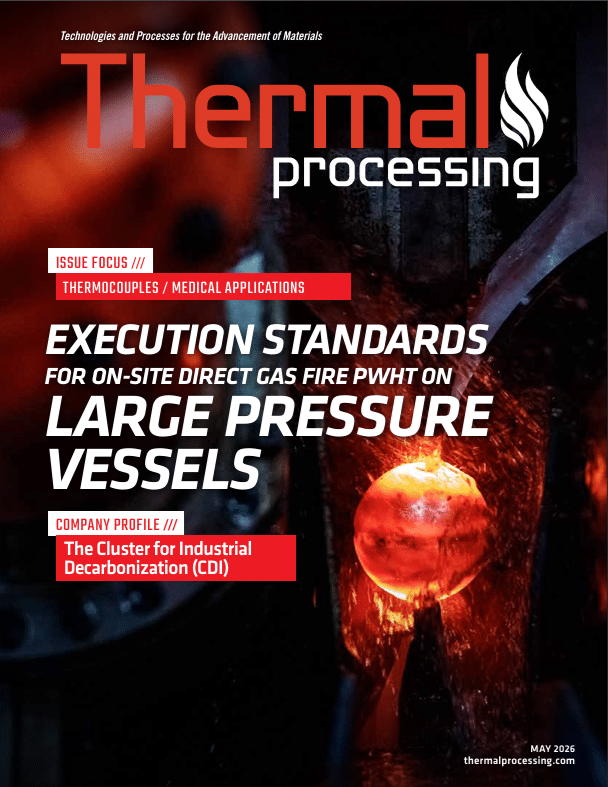
Thermal Processing Magazine — The Industry’s Leading Heat Treating Publication
James Benefield breaks down the execution standards behind every large vessel PWHT job: written execution plan, thermocouple placement, heat cycle calculations, and full documentation.
Documentation Is Part of the Code Requirement
One thing fabricators sometimes overlook is documentation. ASME requires detailed time-temperature records for every PWHT cycle. These records — showing heat-up rate, hold time, hold temperature, and cool-down rate — become part of the permanent record for the vessel.
What GCC Provides on Every Job
Heat treat record (HTR) — signed by GCC and the client representative
Strip chart recorder trace — complete time-temperature history for every thermocouple channel
NIST traceable calibration certificate — confirming recorder accuracy
Execution plan — pre-approved technical plan specific to that vessel, submitted before work begins
On-Site PWHT vs. Shipping to a Furnace
The other common question is whether PWHT can realistically be done on-site at the fabrication shop rather than trucking the vessel to an outside furnace. For large vessels, this isn’t just possible — it’s often the better option. We’ve performed PWHT on vessels that simply couldn’t have been moved without cutting them apart.
No freight. No transport risk. No waiting on another shop’s schedule. If you’re shipping a large vessel to a furnace and something about it feels like a lot of exposure, read this before you book the truck.
| Factor | Shop Furnace | On-Site Direct Gas Fire |
|---|---|---|
| Vessel transport | Required — permits, rigging, transit risk | None. Equipment comes to you. |
| Size limits | Limited by furnace dimensions | No limit. Vessels to 120’+ treated on-site. |
| Schedule | Furnace queue dependent | Scheduled around your timeline. |
| QC witnessing | Off-site — limited visibility | Your QC team on your floor. |
| ASME compliance | Yes — when executed correctly | Yes — same code, full documentation. |
Before You Choose a Heat Treating Method
On-Site vs. Shop Furnace PWHT — The Full Comparison
Cost · Transport Risk · Size Limits · Schedule Control · Documentation
↓
This Is What ASME-Compliant On-Site PWHT Actually Looks Like
James Benefield is involved in every job. Direct gas fire combustion, on-site, right where the vessel sits. No furnace. No transport.
Heat distribution, soak temperature, and chart recorder — 80-foot vessel, Houston, TX. Direct gas fire combustion, on-site.
What Gulf Coast Combustion Offers
On-Site Heat Treating Services
Pressure Vessel PWHT
On-site direct gas fire combustion. No furnace, no transport risk. Vessels from 16ft to 120ft+.
Localized PWHT
For nozzle welds, pipe spools, and vessel repairs where full vessel treatment isn’t required.
Refractory Dry Outs
Controlled cure cycles for new and repaired refractory linings. Full documentation included.
On-site heat cure for ChemLINE, epoxy phenolic, and novolac coating systems. See the California job →
In-House Furnace
30’×10’×10′ furnace in Spring, TX. Up to 25,000 lbs. For components that fit.
Frequently Asked Questions
What materials require PWHT under ASME Section VIII?+
Carbon steel is the most common material requiring PWHT — generally when nominal thickness exceeds 1.5″. Chrome-moly alloys like P91 require higher soak temperatures and longer hold times than carbon steel. Always verify requirements against the applicable code edition and your WPS.
Can PWHT be waived or substituted?+
In some cases, ASME allows alternative measures such as controlled deposition welding or temper bead techniques in lieu of PWHT — but these require specific approval and documentation. When code requires PWHT and no alternative is approved, there is no substitute. Gulf Coast Combustion executes to whatever the governing specification requires.
What documentation does ASME require for PWHT?+
ASME requires a time-temperature record for every PWHT cycle documenting heat-up rate, hold temperature, hold time, and cool-down rate. This record becomes part of the vessel’s permanent documentation. GCC provides a complete package on every job: heat treat record, strip chart recorder trace, NIST traceable calibration certificate, and written execution plan — all delivered before our crew leaves your yard.
Does on-site PWHT meet the same ASME requirements as furnace PWHT?+
Yes. ASME Section VIII specifies parameters — not method. Whether PWHT is performed in a furnace or on-site via direct gas fire combustion, the code requirements are identical. GCC executes to ASME UCS-56 standards on every job with full documentation.
What is the maximum temperature differential allowed during soak?+
ASME Section VIII limits the temperature differential between the highest and lowest thermocouple readings to 100°F during the soak (hold) period. A wider differential of 250°F is allowed during the heat-up and cooldown phases. These two limits apply to different stages of the cycle and are often confused in the field. GCC monitors this continuously via multiple Type K thermocouples placed at intervals not exceeding 15 feet along the vessel length.
How many thermocouples are required for PWHT?+
There is no fixed number. Unlike soak temperature or hold time, which are exact values, thermocouple count is a coverage requirement: enough to prove the entire heated zone reached and held temperature. It is driven by size and geometry — a single pipe weld under localized PWHT may need only one or two, while a large vessel needs many, placed on a grid with spacing that never exceeds 15 feet plus a dedicated thermocouple on every high-mass feature such as a heavy forged nozzle. For the full breakdown, see the complete PWHT guide.
Do you have questions about your specific vessel’s PWHT requirements?+
Call James directly at 832-797-3428. We’ve been navigating ASME requirements on large pressure vessels since 2014 and we’re glad to talk through what your specific project needs before it starts.
Gulf Coast Combustion performs ASME-compliant pressure vessel PWHT across Texas and the Gulf Coast, including Houston, Beaumont/Port Arthur, Corpus Christi, Midland/Odessa, San Antonio, Dallas/North Texas, and Baton Rouge. For the full list see our service areas page. GCC mobilizes anywhere in the contiguous United States.
Where We Work
Serving Fabricators Across Texas and the Gulf Coast
Ready to Get Started?
Talk to James About Your Next Project
Call or text the owner directly at 832-797-3428 — or reach the office at 713-425-3773.