
Before You Choose a Heat Treating Method
On-Site vs. Shop Furnace PWHT — The Full Comparison
Cost · Transport Risk · Size Limits · Schedule Control · Documentation
↓
Read the Full ComparisonThere’s another way to do this
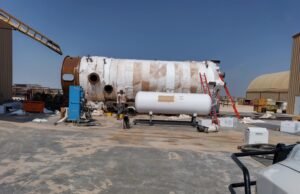
Direct gas fire on-site PWHT means a heat treating contractor comes to your facility. They bring everything: combustion equipment, insulation, thermocouples, strip chart recorders. Your vessel stays on your floor. They wrap it, install the gas train, run the heat cycle to full ASME Section VIII Division 1 compliance, document everything, and break down when it’s done.
New to on-site PWHT? Start here.
The Fabricator’s Complete Guide to Pressure Vessel PWHT covers exactly how on-site direct gas fire combustion works — code requirements, heat cycle parameters, thermocouple placement, and what a complete documentation package looks like.
Read the Complete Guide →No vessel too large
Gulf Coast Combustion runs gas trains up to 6–8 million BTU. There’s no length limitation. We’ve performed on-site PWHT on vessels over 120 feet long. The vessel that won’t fit in a furnace anywhere in your region is a standard mobilization for a contractor set up to do this work. If you want to see what the process looks like, the time lapse above shows a complete PWHT cycle on a 70-foot, 600,000-pound vessel — insulation wrap to strip-out, start to finish, in about 90 seconds. This math gets even more favorable the farther you are from a major furnace shop. Fabricators in Midland, Beaumont, Corpus Christi, Victoria, and across Texas are moving vessels hundreds of miles to a furnace — paying freight both ways — when we can drive to them instead. Outside of Houston, the savings can be significant.When furnace PWHT is still the right call
Smaller vessels with routine transport and no schedule pressure — furnace works fine. High-volume shops running standard-sized vessels through a shop they trust — keep running them. If your current process isn’t causing problems, there’s no reason to change it. But if you’re pricing freight on a large vessel and something about it feels like a lot of exposure, it probably is.Talk to us before you book the truck
Gulf Coast Combustion has performed more on-site pressure vessel PWHT per year than any other mobile heat treating company in the United States, since 2014. We mobilize anywhere in the country. Call 713-425-3773 or visit our heat treating services page. If on-site makes sense for your job, we’ll tell you. If it doesn’t, we’ll tell you that too.On-Site PWHT Pricing
See What Your Job Costs — Instantly.
Enter your vessel specs and get a budgetary estimate in seconds — built from GCC’s actual job data. No email required.
Try the Free Calculator →Frequently Asked Questions
Do you need any special utilities or gas supply at my facility?
We bring everything for the heat cycle itself — combustion equipment, gas trains, insulation, thermocouples, and recorders. Fuel is typically propane, which we supply and bring to the job site, so no natural gas connection is needed at your facility. The one thing we typically use on-site is 480 volt 3-phase power for support equipment. Power draw is low because the actual heating comes from the gas burners, not electricity. Most fabrication shops have this available without any special arrangements.
Is on-site PWHT ASME compliant?
Yes. ASME Section VIII Division 1 specifies temperature requirements, heating and cooling rates, hold times, and documentation — it does not require a furnace. On-site direct gas fire combustion meets every code requirement. The heat treat record, strip chart recorder trace, calibration certificates, and execution plan your customer receives are identical to what a furnace shop provides.
Is on-site heat treating more expensive than sending a vessel to a furnace?
On large vessels, on-site is typically competitive or cheaper once freight is factored in. Oversized load permits, rigging, pilot cars, and two-way transport costs can easily exceed the difference in heat treating price. For very large vessels — those that require special routing or are over weight limits — on-site almost always wins on total cost.
How long does on-site pressure vessel heat treatment take?
It depends on wall thickness, vessel size, and the heat treat procedure. Most jobs run one to three days from setup through breakdown. For a detailed breakdown by vessel size and wall thickness, see our post on how long on-site pressure vessel PWHT takes.
Is there a size limit for on-site PWHT?
No fixed limit. Gulf Coast Combustion has performed on-site PWHT on vessels over 120 feet long. Because we’re not working inside a fixed enclosure, vessel length and diameter don’t constrain us the way they constrain a furnace shop. If it can be built, we can heat treat it on-site.
Can you mobilize on short notice?
Yes. Gulf Coast Combustion handles short-notice and emergency mobilizations. Call James directly at 832-797-3428 — you’ll reach the owner, not a dispatcher.
Do you work outside of Texas?
Yes. Gulf Coast Combustion mobilizes anywhere in the United States. We’re based in Spring, TX and serve fabricators across the Gulf Coast as our primary market, but we regularly work in other states when the job calls for it.
Ready to Get Started?
Talk to James About Your Next Project
Call or text the owner directly at 832-797-3428 — or reach the office at 713-425-3773.
Where We Work
Serving Fabricators Across Texas and the Gulf Coast
Houston | Beaumont/Port Arthur | Corpus Christi | Midland/Odessa | Victoria | San Antonio | Dallas/North Texas | Baton Rouge | Nationwide mobilization available