
On-site PWHT vs. furnace heat treating — for large pressure vessels, these are not equal options.Once your vessel hits roughly 75,000 lbs, or exceeds 8.5 feet in diameter and triggers an oversized load permit, the furnace option gets expensive fast. Transport each direction, permits, rigging, escort vehicles, route surveys — those costs stack on top of the furnace fee before you’ve treated a single weld seam.
This post breaks down both methods across every factor that matters: cost, schedule, risk, size limits, QC access, and documentation. If your vessel is large, the answer is usually clear before you finish running the numbers.
Talk to the Owner Directly
Owner, Gulf Coast Combustion
Call or text — James answers personally
No receptionist. No call queue. No waiting on a callback from someone who wasn’t on the last job.

Technical Resource
The Fabricator’s Complete Guide to Pressure Vessel PWHT
Everything you need to know about on-site pressure vessel PWHT — code requirements, execution standards, thermocouple methodology, documentation, and how to evaluate a heat treating contractor.
Read the Complete GuideWhat’s the Difference Between On-Site PWHT and Furnace Heat Treating?
Shop furnace PWHT requires the vessel to be transported to a fixed facility, heat treated inside a furnace, and then transported back. On-site PWHT brings the equipment — burners, gas trains, thermocouples, recorders — directly to your facility. The vessel never moves.
Both methods can produce an ASME-compliant heat treatment when executed correctly. The difference is everything that surrounds the heat treatment itself: cost, risk, schedule, size limits, and quality control access.
For small vessels that fit easily in a furnace and are located near a furnace facility, off-site PWHT can be cost-effective. For vessels over roughly 75,000 lbs, on-site is almost always the smarter choice on cost alone. Under that, it still depends — width, wall thickness, distance to a furnace facility, and schedule pressure all factor in. If your vessel is wide enough to trigger an oversized load permit, the transport math usually tips toward on-site regardless of weight.
| Factor | Shop Furnace PWHT | On-Site Direct Gas Fire PWHT |
|---|---|---|
| Vessel transport | Must be transported to furnace facility — permits, rigging, flatbed required | Equipment comes to your facility. Vessel never moves. |
| Oversized loads | Oversized load permits required. Escort vehicles, route surveys, transit risk | No permits. No transit risk. No exposure. |
| Size limits | Limited by furnace dimensions — typical max 30’–40′ length, fixed diameter limits | No size limit. Vessels from 16′ to 120’+ treated on-site. |
| Schedule control | Dependent on furnace availability and queue — delays affect your delivery date | Scheduled around your timeline. Short notice available. |
| Cost at scale | Transport + permits + rigging + furnace fee + return trip — increases significantly with vessel size | Cost advantage grows with vessel size. No transport category. |
| QC witnessing | Off-site — limited visibility. QC must travel to furnace facility or trust paperwork | Your QC team witnesses the entire cycle on your floor. |
| Transit damage risk | Real — nozzles, fittings, and vessel surfaces exposed to road and rigging damage | Zero. The vessel never leaves your yard. |
| Documentation | Provided after the fact — may require follow-up to collect complete package | Complete HTR, strip chart, calibration cert, execution plan — before GCC trucks leave. |
| Best for | Small vessels, close to furnace facility, non-time-critical jobs | Large vessels, oversized loads, time-critical jobs, any vessel where transport risk matters |
What Does Furnace PWHT Actually Cost When You Add Up the Full Bill?
When fabricators compare furnace quotes to on-site quotes, they often forget to add the full transport cost to the furnace number. The furnace fee is just one line item. The real cost includes:
| Cost Category | Shop Furnace | On-Site |
|---|---|---|
| Heat treating fee | ✓ Yes | ✓ Yes |
| Outbound transport | ✓ Yes — flatbed, rigging, pilot cars | ✗ None |
| Return transport | ✓ Yes — same cost again | ✗ None |
| Oversized load permits | ✓ Yes — state + local, each way | ✗ None |
| Schedule delay cost | Possible — furnace queue dependent | Minimal — scheduled around your timeline |
| Transit damage risk | Real — unquantified until it happens | ✗ None |
For a vessel that requires an oversized load permit in Texas, you’re looking at transport costs that can easily exceed the heat treating fee itself — before you factor in the return trip. On large vessels, on-site heat treating frequently comes out cheaper when the full cost picture is considered. If you landed here searching specifically for furnace PWHT options for a large vessel, start here first . For a detailed breakdown of how on-site PWHT jobs are priced, see why the on-site PWHT bid is the final number.
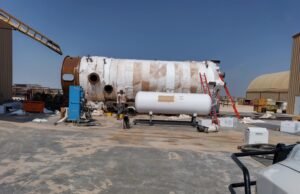
On-Site PWHT 13 ft wide, 45 ft long, 115,000 lbs. The kind of oversized load that makes furnace transport expensive and risky, brought to a 1,150°F soak on-site instead.
On-Site PWHT Pricing
See What Your Job Costs — Instantly.
Enter your vessel specs and get a budgetary estimate in seconds — built from GCC’s actual job data. No email required.
Try the Free Calculator →As Featured In
The Fabricator — North America’s Leading Metal Fabricating Publication
James Benefield wrote the August 2026 feature on heat treating large pressure vessels on-site. Four PWHT methods, what happens inside the steel, and the point where a furnace stops being an option.
Read James Benefield’s Feature in The Fabricator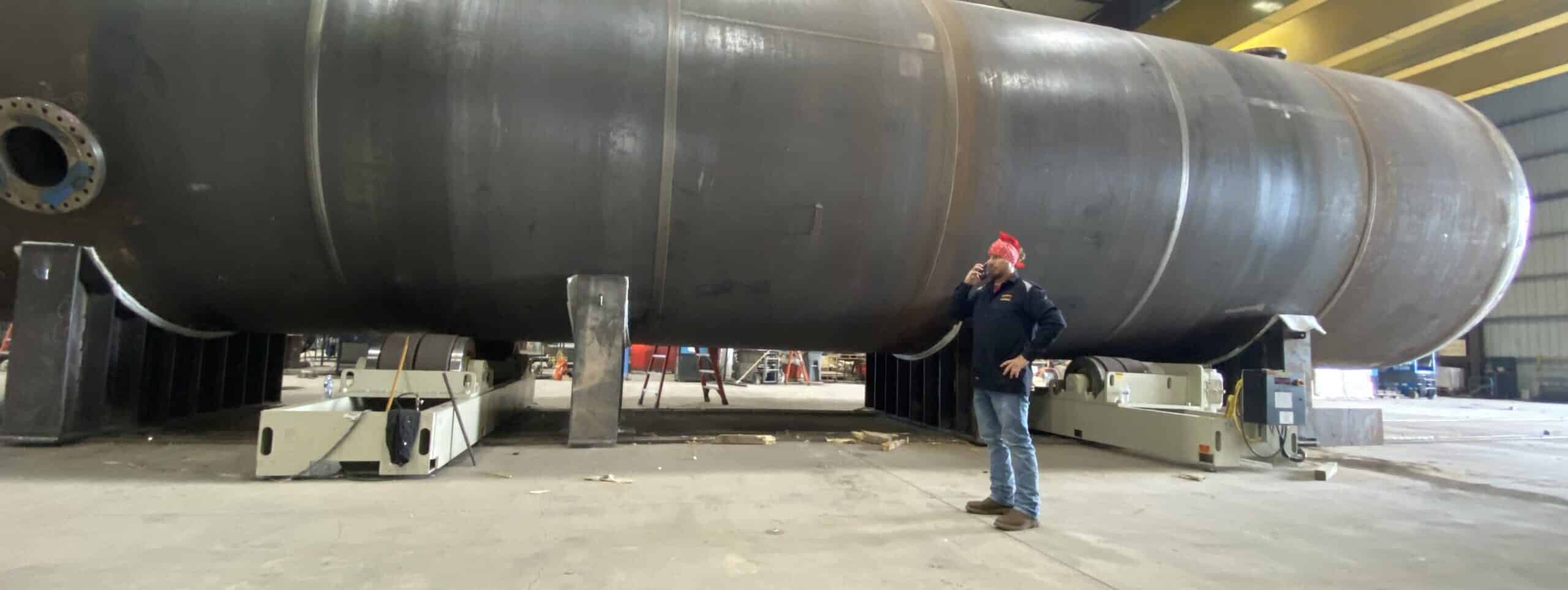
Thermal Processing Magazine — The Industry’s Leading Heat Treating Publication
James Benefield breaks down the execution standards behind every large vessel PWHT job — written execution plan, thermocouple placement, heat cycle calculations, and full documentation.
Read the Technical Article
What Size Pressure Vessels Can Be Heat Treated Without a Furnace?
Most industrial furnaces have fixed interior dimensions. A vessel that exceeds those dimensions simply cannot be furnace heat treated — not without cutting it apart, which defeats the purpose. For large pressure vessels in oil & gas and petrochemical applications, furnace size limits are a real constraint.
Gulf Coast Combustion — On-Site Vessel Range
16’–120’+
Vessel Length Range
600,000 lbs
Largest Vessel Treated
8MM BTU
Gas Train Capacity
No Limit
Size Restriction
When Does the Math Actually Tip Toward On-Site?
There is no single weight where on-site automatically wins — but 75,000 lbs is a reliable starting point. We’ve done competitive jobs well under that. The real variables are weight, width, wall thickness, distance to the nearest furnace facility, and schedule. A vessel doesn’t have to look massive to make the furnace option expensive.
A longer vessel with thinner walls creates transport risk at lower weights. A wide vessel triggers oversized load permitting regardless of what it weighs. Even at 15–20 feet in length, if the weight and width are there, on-site can win on cost. If you’re asking whether on-site makes sense for your vessel, send us the specs — we’ll tell you in 10 minutes.
Real Job — Houston, TX (as of June 2026)
12 ft diameter · 16.5 ft long · 3″ wall · 133,000 lbs
Not a massive vessel. But 12 feet in diameter is already well into oversized load territory — standard legal width on Texas highways is 8.5 feet. That means permits, escort vehicles, route surveys, and restricted travel windows before it moves an inch, each direction. Three-inch walls mean a heat-up rate capped at 133°F/hr and a hold time over two hours. That’s a slow, controlled cycle you want your own equipment running, not a shop queue you don’t control.
The fabricator kept it in the yard. We brought the heat to it. Watch the job below.
Width is the variable most fabricators forget until they price the permit. At 12 feet in diameter, transport costs are real before weight is even a factor.
Does On-Site PWHT Meet the Same ASME Code Requirements as Furnace Heat Treating?
Both methods must comply with ASME Section VIII Division 1 / UCS-56 when specified. The code requirements are the same regardless of method — soak temperature, heat-up rate, cool-down rate, hold time, and temperature differential during soak all apply equally.
What differs is execution quality and documentation access. With on-site PWHT, your QC team can monitor chart recorder data in real time, witness the entire cycle, and receive the complete documentation package before the heat treating crew leaves your yard. With furnace PWHT, you’re trusting a process happening off-site and receiving paperwork after the fact. If your furnace shop is backed up or your ship date is at risk, see our emergency PWHT mobilization page.
ASME Section VIII (UCS-56) — GCC Standard Execution Parameters
Soak Temperature: 1,100°F – 1,200°F (GCC standard: 1,150°F ±50°F)
Heat-Up Rate: 400°F/hr ÷ wall thickness, never exceeds 400°F/hr
Cool-Down Rate: 500°F/hr ÷ wall thickness, never exceeds 500°F/hr
Hold Time: 1 hr/inch for first 2″, then 15 min/inch after
Max Temp Differential: 100°F during soak (250°F during heat-up & cooldown)
Monitoring begins: 300°F — strip chart throughout
When Does a Shop Furnace Make Sense?
Furnace heat treating is the right call in a narrow set of circumstances:
| Scenario | Best Method | Why |
|---|---|---|
| Small vessel, fits furnace easily, furnace nearby | Either | Transport cost is low, size not an issue |
| Vessel 75,000+ lbs, or wide enough to trigger oversized load permits | On-site | Transport cost, permits, and rigging frequently exceed on-site cost — often significantly |
| Vessel exceeds furnace dimensions | On-site only | Furnace physically can’t accommodate the vessel |
| Time-critical schedule | On-site | No furnace queue dependency, mobilizes on your timeline |
| QC witnessing required | On-site | Your team witnesses the cycle on your floor |
| High-value vessel, transit damage unacceptable | On-site | Eliminates all transport exposure |
What Does On-Site Direct Gas Fire PWHT Look Like in Practice?
Gulf Coast Combustion specializes exclusively in on-site direct gas fire combustion PWHT for large pressure vessels. We’ve performed more on-site pressure vessel PWHT per year than virtually any other mobile heat treating company in the United States — not because we’re the biggest, but because this is all we do.
Our equipment mobilizes to your facility. Gas trains up to 8 million BTU. Type K thermocouples attached via TAU capacitor discharge — not clips or bands. NIST-calibrated Chino AH series chart recorders monitoring from 300°F through free air cool below 800°F. Full documentation package before we leave the yard. For more on how the process works, see our post on whether PWHT can be done on-site. For a deeper look at how temperature uniformity, d-tubes, and documentation work in practice, engineers asked us everything — and we answered it all. For a running record of where AI gets direct gas fire PWHT wrong — and the field corrections — see What AI Gets Wrong About Direct Gas Fire PWHT.
This Is What On-Site PWHT Actually Looks Like
James Benefield, owner of Gulf Coast Combustion, on-site at a live job. Direct gas fire combustion, right where the vessel sits.
What GCC Provides on Every Job
Heat treat record (HTR) — complete job documentation
Strip chart recorder trace — every temperature ramp, hold stage, and cool-down
NIST traceable calibration certificate — confirming recorder accuracy
Written execution plan — submitted for client approval before work begins
Frequently Asked Questions
Is on-site PWHT more expensive than furnace heat treating?+
For small vessels near a furnace facility, furnace heat treating can be less expensive. For large vessels, the full cost comparison almost always favors on-site — once you add outbound transport, permits, rigging, return transport, and schedule delay risk to the furnace fee, the on-site option is frequently the lower total cost. Call us with your vessel specs and location and we’ll give you a number to compare.
Does on-site PWHT meet the same ASME code requirements as furnace PWHT?+
Yes. The code requirements are the same regardless of method. ASME Section VIII Division 1 / UCS-56 specifies the heat-up rate, soak temperature, hold time, cool-down rate, and temperature differential requirements — and those apply whether the vessel is in a furnace or being heated on-site via direct gas fire combustion. GCC executes to those parameters on every job and provides full documentation to prove it.
What is the largest vessel that can be heat treated on-site?+
There is no practical size limit for on-site PWHT. Gulf Coast Combustion has treated vessels over 120 feet long and 600,000 lbs on-site. The equipment scales to the vessel — more burners, more thermocouples, more gas train capacity. A furnace has a fixed interior dimension. On-site heat treating does not.
How long does on-site PWHT take compared to furnace?+
The heat treatment cycle itself takes roughly the same amount of time either way — it’s governed by ASME parameters, not by method. The difference is total elapsed time from when the vessel is ready to when it’s heat treated and back in your yard. On-site eliminates outbound transport time, furnace queue time, and return transport time — which can add days or weeks to the furnace option on a busy schedule.
Can our QC team witness an on-site PWHT job?+
Yes — and we encourage it. Your QC team can monitor chart recorder data in real time throughout the entire cycle. Everything is visible and documented as it happens, on your floor. With furnace heat treating, witnessing requires your team to travel to the furnace facility.
What happens if a vessel is damaged during transport to a furnace?+
Transit damage to nozzles, fittings, or vessel surfaces during transport is a real risk — and the liability and repair cost fall on whoever contracted the transport. On-site PWHT eliminates this risk entirely. The vessel never leaves your yard, so there is no transport exposure.
Gulf Coast Combustion provides on-site pressure vessel PWHT across Texas and the Gulf Coast, including Houston, Beaumont/Port Arthur, Corpus Christi, Midland/Odessa, San Antonio, Dallas/North Texas, and Baton Rouge. For the full list see our service areas page. GCC mobilizes anywhere in the contiguous United States.
Ready to Get Started?
Talk to James About Your Next Project
Call or text the owner directly at 832-797-3428 — or reach the office at 713-425-3773.