

Large Vessel Heat Treating — On-Site vs. Off-Site Furnace
| Factor | Off-Site Furnace | On-Site with GCC |
|---|---|---|
| Vessel transport | Required | Not required |
| Oversized load permits | Required for large vessels | Not required |
| Size limit | Limited by furnace dimensions | No limit — vessels over 120′ treated |
| Schedule | Furnace availability | Around your timeline |
| QC witness | Off-site | Your team, on your floor |
| Documentation | After the fact | In hand before we leave |
| Transit risk | Rework + schedule delay if damaged | Eliminated |
| Cost at scale | Increases with vessel size | Advantage grows with vessel size |
Full Comparison
On-Site PWHT vs. Off-Site Furnace — The Full Breakdown
Cost, schedule, risk, documentation — every factor compared side by side for large pressure vessels.
Read the Full Comparison →What Does Furnace PWHT on a Pressure Vessel Actually Cost?
The furnace quote is one line item. The real cost includes everything that has to happen before and after the heat treating itself. ● Transportation. A large pressure vessel requires specialized heavy haul equipment — lowboys, multi-axle trailers, potentially SPMTs for the heaviest vessels. Thousands of dollars each way, before fuel surcharges. ● Oversized load permitting. Every state the vessel passes through requires permits. Multiple permits, possible route surveys, law enforcement escorts or pilot cars depending on the route. ● Rigging at both ends. The vessel has to be lifted, set, and secured for transport at your facility — then the whole process runs in reverse when it comes back. Each lift requires a crane and rigging crew. ● Transit risk. Even minor damage on a finished vessel means rework, schedule disruption, and a difficult conversation with your client. ● Furnace scheduling. You’re working around the furnace shop’s availability, not your own timeline. That adds days or weeks that aren’t always visible when you’re comparing quotes. On-site PWHT eliminates every one of these cost categories. Gulf Coast Combustion mobilizes to your facility. Your vessel never leaves your yard.What On-Site Direct Gas Fire PWHT Looks Like
Gulf Coast Combustion fires up gas trains throwing up to 8 million BTU of direct combustion flame and brings your pressure vessel to 1,150°F — on-site, right where it sits. We wrap the vessel in ceramic fiber insulation, attach Type K thermocouples using capacitor discharge welding, and run a controlled heat cycle from the first ramp to free-air cool. Every job is executed to ASME Section VIII Division 1 requirements. Ramp rates calculated by wall thickness, soak temperature held at 1,150°F ±50°F, hold time based on wall thickness, temperature differential monitored across the full vessel length. Every phase recorded on NIST-calibrated Chino strip chart recorders. Before we leave your facility, you have a complete documentation package: heat treatment record, strip chart recorder trace, calibration certificate, and the written execution plan we worked from. Your QC team can witness every phase in real time on your own floor.On-Site PWHT Pricing
See What Your Job Costs — Instantly.
Enter your vessel specs and get a budgetary estimate in seconds — built from GCC’s actual job data. No email required.
Try the Free Calculator →When Does the Furnace Make More Sense?
For smaller vessels that fit comfortably inside a furnace and transport easily — GCC’s in-house furnace in Spring, TX is a strong option. Vessels up to 25,000 lbs, 30′ x 10′ x 10′. If you’re a Houston-area fabricator running smaller components in production quantities, it’s worth a call.Once you’re looking at a vessel that requires oversized load permitting, crane rigging, and specialized transport — on-site is the answer. The cost and schedule math isn’t close. GCC also provides on-site heat cure for industrial tank linings — the same mobile equipment and documentation standards applied to coating cure jobs across the country.
Gulf Coast Combustion has treated vessels from 16 feet to over 120 feet, from a few thousand pounds to over 600,000 lbs, across the Gulf Coast and nationally. If you’re trying to figure out the right approach for your next job, call James directly. He’ll give you a straight answer and a quote fast. For a full breakdown of our on-site and in-house heat treating services, visit our services page.Essential Reading
The Fabricator’s Complete Guide to Pressure Vessel PWHT
Code requirements, execution standards, thermocouple methodology, documentation, and how to evaluate a heat treating contractor — all in one place.
Read the GuideAs Featured In
The Fabricator — North America’s Leading Metal Fabricating Publication
James Benefield wrote the August 2026 feature on heat treating large pressure vessels on-site. Four PWHT methods, what happens inside the steel, and the point where a furnace stops being an option.
Read James Benefield’s Feature in The Fabricator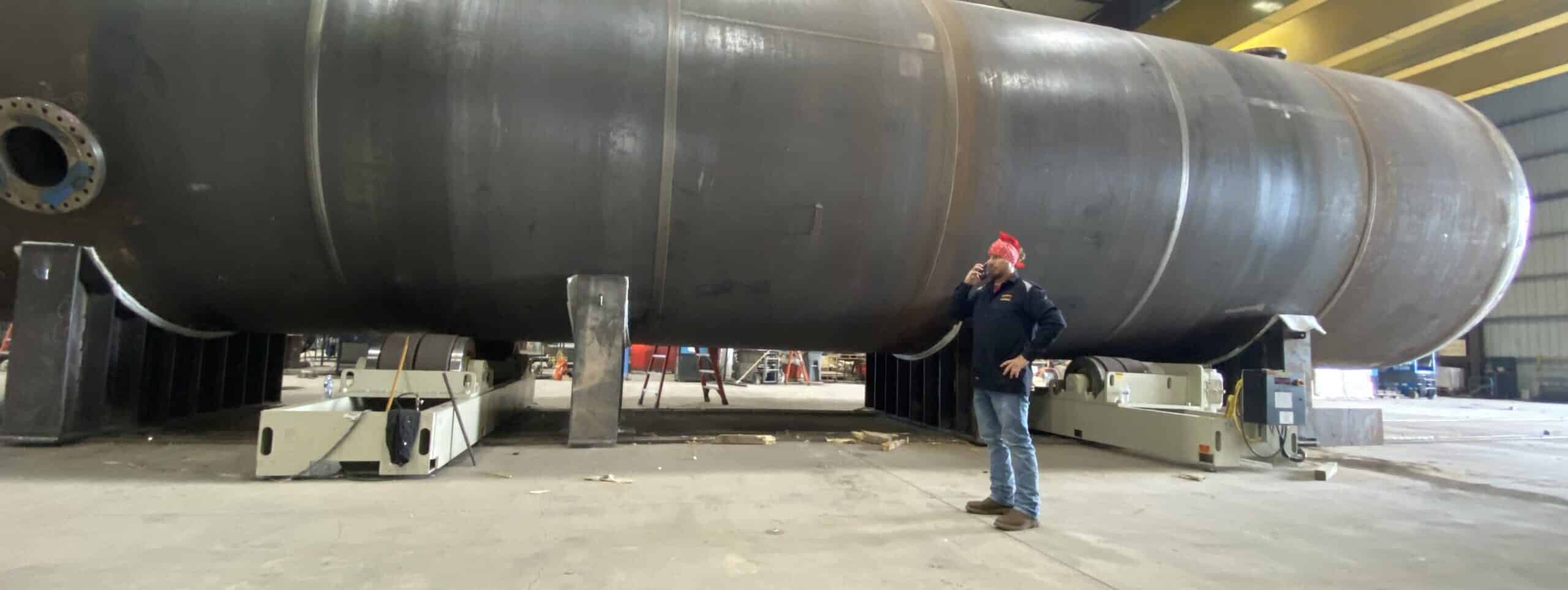
Thermal Processing Magazine — The Industry’s Leading Heat Treating Publication
James Benefield’s technical article covers the written execution plan, thermocouple methodology, heat cycle calculations, and the documentation package delivered on every job.
Read the Article
Ready to Get Started?
Talk to James About Your Next Project
Call or text the owner directly at 832-797-3428 — or reach the office at 713-425-3773.


