
Yes. Post weld heat treatment can absolutely be done on-site — and for large, heavy pressure vessels, it’s almost always the right call. Gulf Coast Combustion has been performing on-site PWHT using direct gas fire combustion since 2014, mobilizing directly to fabrication shops and plant sites across the Gulf Coast and the U.S. Here’s how it works and when it makes sense for your project.
| Factor | Shop Furnace PWHT | On-Site with Gulf Coast Combustion |
|---|---|---|
| Vessel transport | Must be transported to furnace facility | Equipment comes to your facility |
| Oversized loads | Permits and special transport required | No permits or transport risk |
| Scheduling | Dependent on furnace availability and queue | Scheduled around your timeline |
| Size limit | Limited by furnace dimensions | No size limit — vessels over 120′ treated |
| Cost at scale | Increases significantly with vessel size and transport distance | Cost advantage grows with vessel size |
| QC witnessing | Off-site, limited visibility | Your QC team witnesses directly on your floor |
Technical Resource
The Fabricator’s Complete Guide to Pressure Vessel PWHT
Everything you need to know about on-site pressure vessel PWHT — code requirements, execution standards, thermocouple methodology, documentation, and how to evaluate a heat treating contractor.
Read the Complete GuideThis Is What On-Site PWHT Actually Looks Like
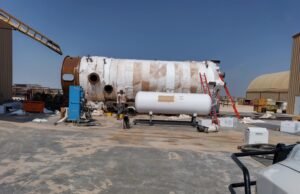
James Benefield is involved in every job. Direct gas fire combustion, on-site, right where the vessel sits. No furnace. No transport.
Time lapse: 621,000 lb vessel, Central Texas. Direct gas fire combustion, on-site.
Talk to the Owner Directly
James Benefield
Owner, Gulf Coast Combustion
Call or text — James answers personally. No receptionist. No call queue. No waiting on a callback from someone who wasn’t on the last job.
When On-Site PWHT Is the Right Call
On-site is the right call in most large vessel situations. Here are the scenarios where it consistently wins:
The vessel is too large to transport. Oversized load permitting, rigging, crane time, and specialized transport equipment all add cost — and risk. For vessels over 25,000 lbs, on-site heat treating is almost always more cost-effective. Gulf Coast Combustion has performed PWHT on vessels over 120 feet long and up to 600,000 pounds. There is no furnace that handles that.
The vessel is already set in position. Repair welds, maintenance PWHT, and in-plant work don’t have a transport option. If the vessel is already positioned at a facility, on-site is the only practical method.
Your customer wants to witness the process. When your end client requires QC witnessing of the heat treat cycle, on-site PWHT puts your team and theirs in the same room. The strip chart recorder runs in front of everyone, and documentation is in hand before the crew leaves.
Your schedule can’t absorb furnace lead time. Furnace facilities have queues. Coordinating transport, furnace availability, and return transport adds days or weeks to a project. On-site PWHT is scheduled around your timeline.
The vessel carries transportation risk. A finished, precision-fabricated pressure vessel is not a simple load. Transit damage happens. On-site eliminates that exposure entirely.
The job involves multiple vessels at one location. Batching on-site PWHT across multiple vessels at a single shop reduces mobilization cost and often makes the per-vessel economics significantly better than furnace PWHT.
Before You Choose a Heat Treating Method
On-Site vs. Shop Furnace PWHT — The Full Comparison
Cost · Transport Risk · Size Limits · Schedule Control · Documentation
↓
Read the Full ComparisonHow On-Site Direct Gas Fire PWHT Works
Gulf Coast Combustion uses high-velocity direct gas fire combustion for on-site pressure vessel PWHT. High-velocity gas burners fire directly through the vessel’s available nozzles and manways. The vessel, wrapped in 1-inch 8-lb Kaowool ceramic fiber insulation, becomes its own furnace. Type K thermocouples attached directly to the vessel surface via TAU capacitor discharge welding monitor temperature at multiple points simultaneously.
The heat cycle records continuously on a Chino strip chart recorder from first heat through cool-down. Every job follows a custom execution plan submitted to the client for approval before work begins, defining soak temperature, hold time, heat-up and cool-down rates, and thermocouple placement.
For carbon steel pressure vessels under ASME Section VIII Division 1, GCC’s standard parameters:
- Soak temperature: 1,100°F–1,200°F (GCC standard: 1,150°F ±50°F)
- Heat-up rate: 400°F/hr ÷ governing wall thickness; never exceeds 400°F/hr
- Hold time: 1 hour/inch for first 2 inches, then 15 minutes/inch after 2 inches
- Cool-down rate: 500°F/hr ÷ governing wall thickness; never exceeds 500°F/hr
- Max temperature differential during soak: 100°F
What You Receive at Job Completion
Every Gulf Coast Combustion job ships with a full documentation package before the crew leaves the job site:
- Heat Treatment Record (HTR) — signed by GCC and the client representative
- Strip chart recorder trace — the complete time-temperature history for every thermocouple channel
- NIST traceable calibration certificate — confirming recorder accuracy
- Execution plan — the pre-approved technical plan specific to that vessel
That documentation becomes part of the vessel’s permanent record. No waiting for paperwork from an outside facility.
By the Numbers
144+ feet — longest vessel GCC has heat treated on-site
600,000 lbs — heaviest vessel GCC has heat treated on-site
8 million BTU — gas train capacity per console
Since 2014 — more on-site vessel PWHT per year than any other mobile heat treating company in the U.S.
Every job — full documentation package before crew leaves site
Frequently Asked Questions
Is on-site PWHT as code-compliant as furnace PWHT?
Yes. ASME Section VIII Division 1 does not specify a method — it specifies parameters. Whether PWHT is performed in a furnace or on-site via direct gas fire combustion, the code requirements are identical: controlled heat-up rate, verified soak temperature and hold time, controlled cool-down rate, and full documentation. Gulf Coast Combustion executes every job to ASME UCS-56 standards with a complete documentation package on every job.
What size vessels can be heat treated on-site?
On-site direct gas fire combustion has no furnace-size limitation. Gulf Coast Combustion has performed PWHT on vessels over 120 feet long and up to 600,000 pounds. Burner count and placement are calculated based on vessel weight and geometry to ensure uniform heating. If a vessel can be built and set at your facility, it can be heat treated there.
How long does on-site PWHT take from mobilization to completion?
Most on-site jobs run 36 to 72 hours from setup to strip out, including insulation wrap, thermocouple attachment, the controlled heat-up cycle, soak period, controlled cool-down, and equipment removal. Wall thickness is the biggest variable — thicker walls require slower rates and longer soak times. GCC provides a custom execution plan before every job with the expected timeline.
Can PWHT be performed on a vessel already set in position at a plant?
Yes. This is one of the main advantages of on-site heat treating. Gulf Coast Combustion has performed PWHT on vessels already set in position at plant sites and fabrication shops across the United States — including repair welds, nozzle modifications, and in-plant maintenance jobs where the vessel cannot be moved.
Where does Gulf Coast Combustion perform on-site PWHT?
GCC is based in Spring, TX and mobilizes anywhere in the United States. Primary markets include Houston, Beaumont/Port Arthur, Corpus Christi, Midland/Odessa, Dallas, Baton Rouge, Oklahoma, and Wyoming. For a full list, see our service areas page.
For more on the full on-site PWHT process, code requirements, and how to evaluate a heat treating contractor, read The Fabricator’s Complete Guide to Pressure Vessel PWHT. For common questions answered in plain language, see our PWHT FAQ. For a full overview of GCC’s heat treating services — including localized PWHT, refractory dry outs, and in-house furnace options — visit our services page.
Ready to Get Started?
Talk to James About Your Next Project
Call or text the owner directly at 832-797-3428 — or reach the office at 713-425-3773.