
When Gulf Coast Combustion shows up on a job site, the heat treatment equipment setup is what the industry calls gas train equipment. It’s the core of direct gas fire combustion heat treating — the method GCC has specialized in since 2014. Here’s a breakdown of what each component is, what it does, and why it matters for on-site PWHT.
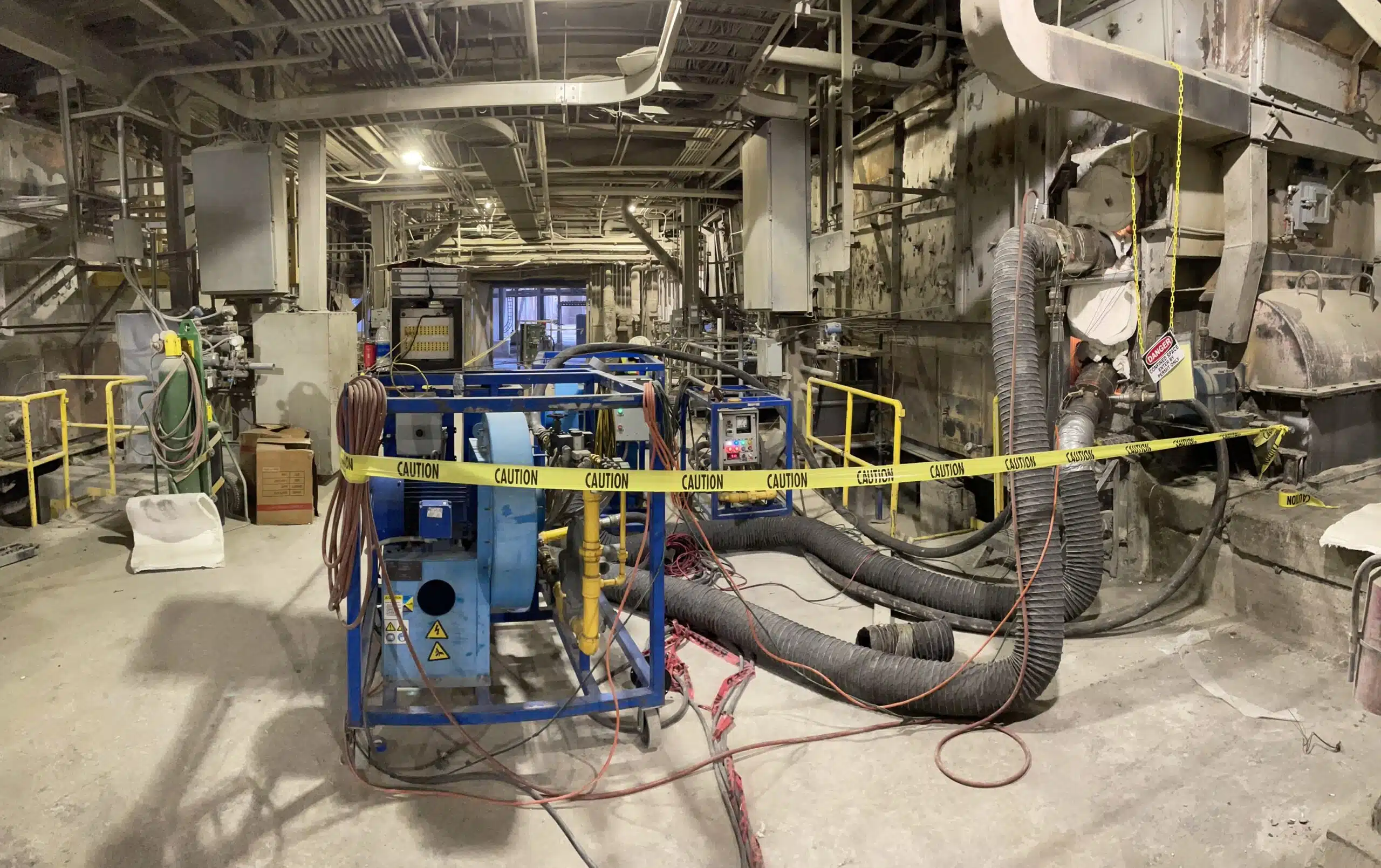
Gas train equipment deployed on a GCC job site — blowers, control consoles, and burner hoses ready for a direct gas fire heat treating cycle.
GCC Gas Train — By the Numbers
8MM
BTU per gas train
60′
Heat projection range
1 psi
Blower air pressure
3
Burner sizes available
The Blower
The blower provides the air needed for combustion. It forces air at approximately 1 psi into the burner, where it mixes with fuel to produce the high-velocity flame. The pressure from the hot gases leaving the burner can project heat up to 60 feet into the vessel — which is what makes this method effective for large-diameter, long-run pressure vessels that need even heat distribution across significant internal volume.
The Control Console
The control console manages fuel flow and monitors the burner. It contains the gas regulator and ignition transformer, verifies correct fuel pressure, and monitors the flame continuously. If flame loss occurs, an alarm sounds and fuel supply shuts down automatically.
The gas regulator reduces incoming gas pressure to 1–2 psi for use with the control train. It’s adjustable, which allows for a controlled low-temperature start-up — important for code-compliant heat-up rates on thick-walled vessels.
The ignition transformer provides 8,000–10,000 volts to the spark electrode to light the burner. It’s designed for intermittent use, not continuous operation.
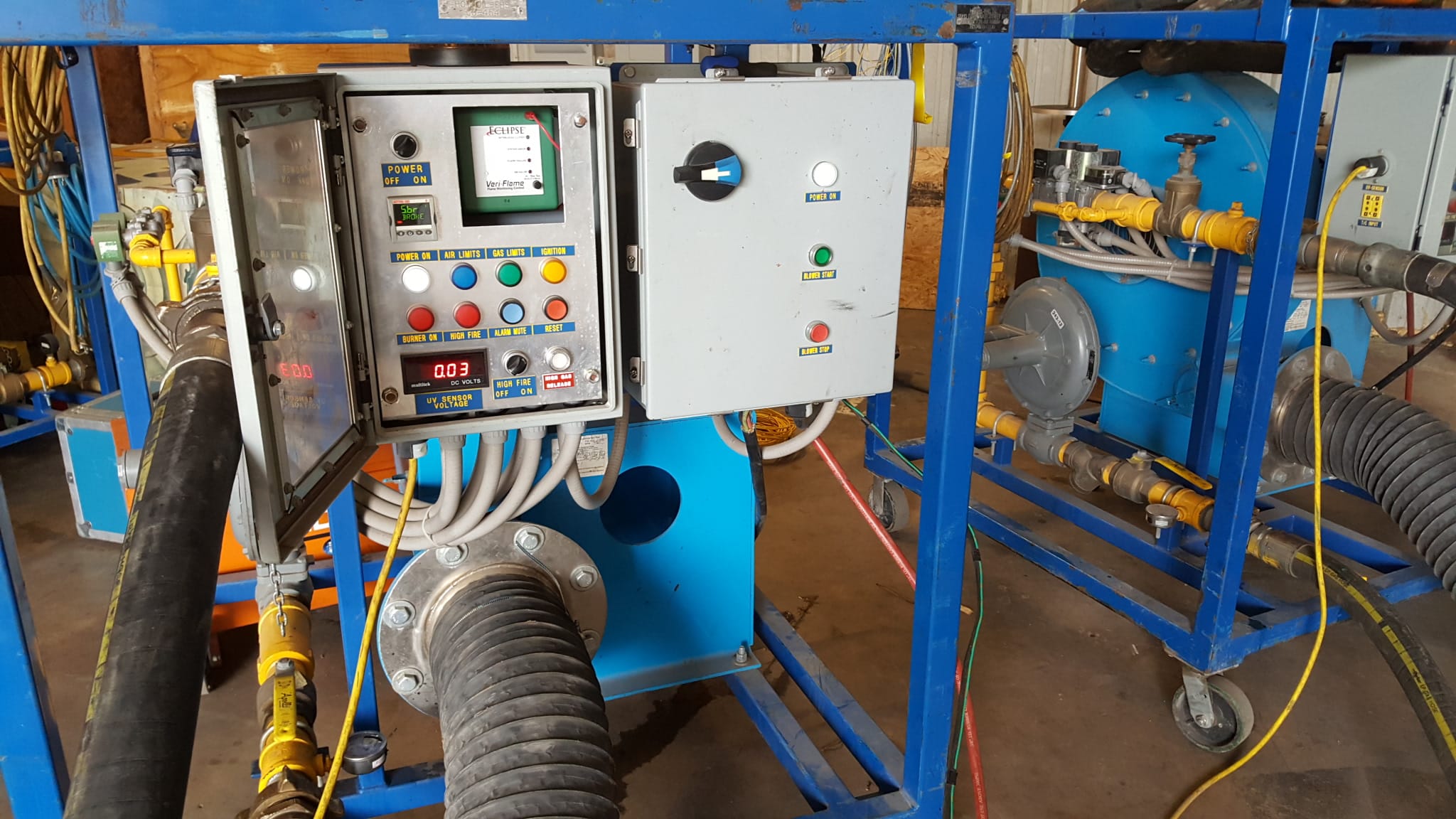
GCC control console — manages fuel flow, flame monitoring, and automatic safety shutoff during direct gas fire heat treating.
High-Velocity Gas Burners
GCC uses two burner sizes depending on job requirements: 3 million BTU/hr, and up to 8 million BTU/hr. The 8 million BTU burner is used most often on large vessel firings where significant heat output and air volume are required.
All are nozzle-mix burners — meaning gas and air mix at the burner tip rather than upstream, which provides precise control over the combustion process. The 8 million BTU unit is stainless steel with an 8-inch air inlet and a standard 2-inch gas hose connection.
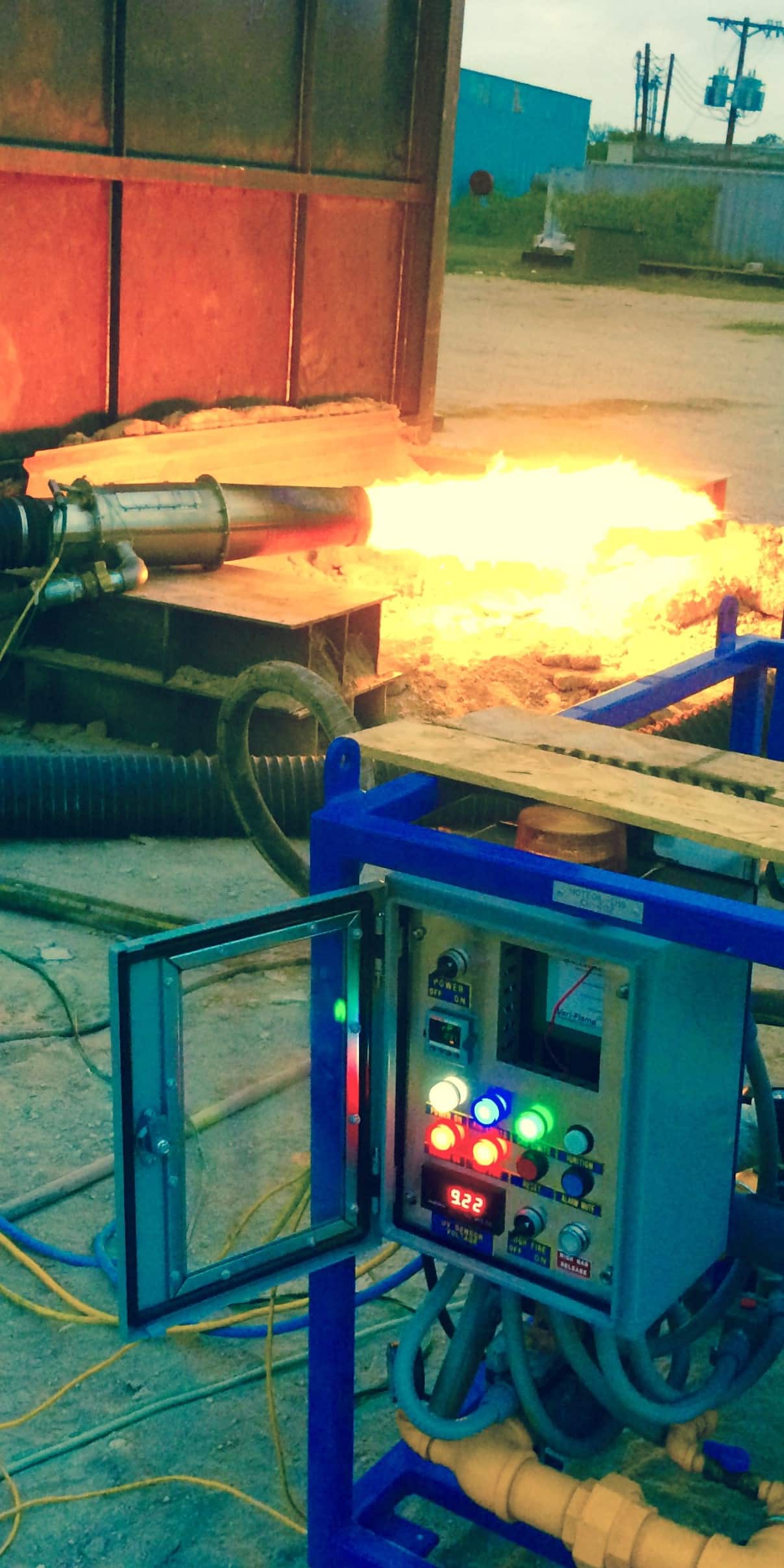
High-velocity gas burner firing at full output — direct gas fire combustion pushing heat into the vessel interior.
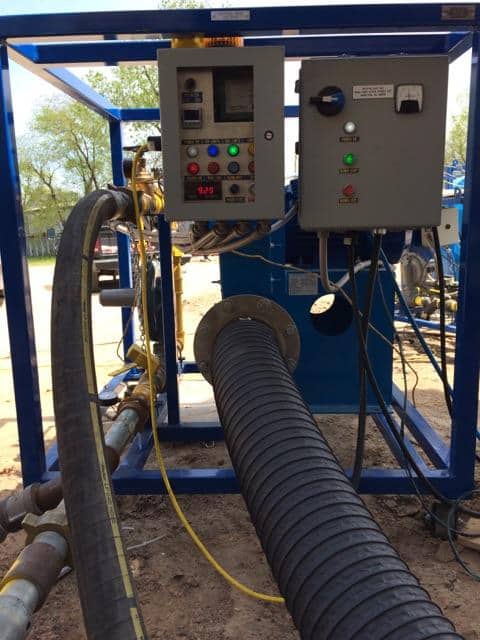
Full gas train unit on a pressure vessel PWHT job site — blower, control console, and burner hose connected and ready.
The Vaporizer
A vaporizer is required when the fuel source is in liquid state — most commonly when using LPG on job sites without a natural gas supply. LPG is stored and transported as a liquid under pressure. Before it can be combusted, it has to undergo a phase change from liquid to vapor. The vaporizer handles that conversion.
When a client has a natural gas supply at their facility, GCC can connect directly to it — no vaporizer needed, and typically a meaningful cost savings for the client.
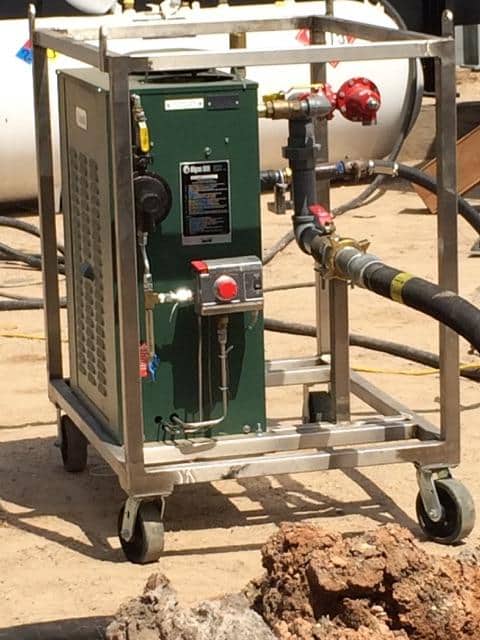
LPG vaporizer unit — converts liquid propane to vapor before combustion on job sites without a natural gas supply.
How Heat Treatment Equipment Works on a Job
On a pressure vessel PWHT job, the gas train is positioned outside or adjacent to the vessel. Burners are installed through available nozzles and manways. The vessel, wrapped in ceramic fiber insulation, becomes its own furnace. High-velocity combustion drives heat throughout the interior, and Type K thermocouples attached directly to the vessel surface monitor temperature in real time on a strip chart recorder.
The result is a controlled, documented heat cycle that meets ASME Section VIII requirements from heat-up through cool-down. Every job includes a full documentation package — time-temperature chart, calibration certificate, and daily work record.
The same gas train equipment is also used for refractory dry outs — the heat cycle parameters and target temperatures differ, but the blowers, burners, and control consoles are the same setup. For a full breakdown of how refractory dry out works and why the cure cycle matters, see The Complete Guide to Refractory Dry Out.
The Heat Cycle at a Glance
| Phase | What Happens | Rate |
|---|---|---|
| Heat-Up | Gas train fires, vessel temperature rises from ambient to soak temp | 400°F/hr max per ASME |
| Soak | Vessel held at 1,150°F ±50°F — residual weld stress relieves | 1 hr/inch for first 2″, then 15 min/inch |
| Cooldown | Controlled cool to below 800°F, then free air cooling to ambient | 500°F/hr max to 800°F |
Go Deeper
The Fabricator’s Complete Guide to Pressure Vessel PWHT
Code requirements, heat cycle parameters, thermocouple placement, documentation, and what to demand from your heat treating contractor.
Read the Full Guide →From the Field
Engineers Asked Us Everything About On-Site PWHT
How d-tubes work, how temperature stays uniform across 55 feet, why the vessel doesn’t buckle, what the documentation looks like — all answered directly from the field.
Read the Q&A →Where Gulf Coast Combustion Works
Gulf Coast Combustion deploys this equipment throughout the Gulf Coast and across the U.S., mobilizing directly to your facility for on-site PWHT and refractory dry outs. For a full overview of services, visit our services page.
Service Areas:
Houston / Gulf Coast· Midland / Permian Basin· San Antonio· Dallas / North Texas· Corpus Christi· Beaumont / East Texas· Baton Rouge / Louisiana· Oklahoma· NationwideReady to Get Started?
Talk to James About Your Next Project
Call or text the owner directly at 832-797-3428 — or reach the office at 713-425-3773.