On-Site PWHT Execution Standards: James Benefield in Thermal Processing
Thermal Processing magazine published a technical article this week by James Benefield, owner of Gulf Coast Combustion, on the execution standards for on-site direct gas fire post weld heat treatment of large pressure vessels.
The full article is available now at Thermal Processing: Execution Standards for on-site direct gas fire PWHT on large pressure vessels.
The piece is not a company profile. It is a working breakdown of how large vessel PWHT actually gets done correctly, written by the person who runs the jobs. James started in heat treating around 2007 and founded Gulf Coast Combustion in 2014. Nearly two decades in, the article reads like field experience, not marketing.
Technical Resource
The Fabricator’s Complete Guide to Pressure Vessel PWHT
Everything you need to know about on-site pressure vessel PWHT — code requirements, execution standards, thermocouple methodology, documentation, and how to evaluate a heat treating contractor.
THERMAL PROCESSING MAGAZINE — Execution Standards for On-Site Direct Gas Fire PWHT on Large Pressure Vessels
Gulf Coast Combustion owner James Benefield breaks down the execution standards behind every large vessel PWHT job — written execution plan, thermocouple placement, heat cycle calculations, and full documentation.
For fabricators, quality managers, and inspectors trying to evaluate a heat treating contractor, the article is a useful yardstick. Here is what it covers.
The Standard Starts Before Mobilization
Every job begins with a written execution plan built for the specific vessel, not a generic template. It defines the governing code, wall thickness, material specification, soak temperature and tolerance, hold time, ramp rate limits, thermocouple count and placement, burner assignment, and insulation specification. Management and QC sign off before any job starts. The plan becomes the controlling document for the entire heat cycle.
Accurate Temperature Measurement Is Non-Negotiable
The article spends real time on thermocouple attachment, because the entire compliance case rests on it. Gulf Coast Combustion welds Type K thermocouples directly to the vessel surface with a capacitor discharge spot welder, making the steel surface itself the measurement point. Clips, banding wire, and welded nuts hold the junction away from the surface and introduce measurement error under PWHT conditions. Placement follows a grid pattern with spacing never exceeding 15-foot intervals, and high-mass features like heavy forged nozzles get their own thermocouples.
The Heat Cycle Is Calculated, Not Estimated
Heat-up and cool-down rates are tied directly to wall thickness. Under ASME Section VIII, the heat-up rate above 800°F is 400°F per hour divided by the governing wall thickness in inches, capped at 400°F per hour. Soak begins only when every thermocouple has reached temperature, not when the first one does. Hold time is calculated from wall thickness. The article walks through why each parameter exists and what happens to the steel when a contractor pushes past it.
A 621,000-Pound Case Study
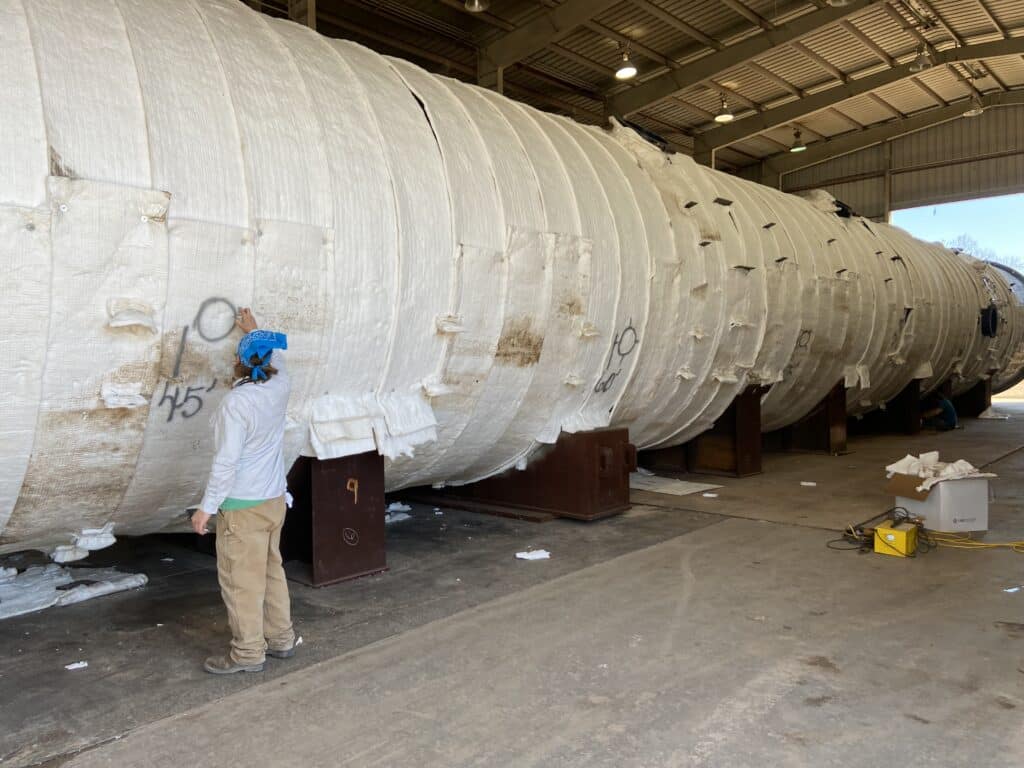
The article includes a Central Texas job: a vessel 69 feet shell-to-shell, 16.5 feet in diameter, 3-inch wall, 621,000 pounds. Moving a vessel that size to a furnace means heavy-haul permitting, rigging at both ends, and real transit risk to a finished vessel. On-site was the right call. Gulf Coast Combustion mobilized seven high-velocity gas burners, attached eighteen thermocouples, and executed to a client specification tighter than the code maximum. The full job is documented in time lapse footage that shows the sequence from insulation and setup through firing, soak, and strip.
Why Execution Standards Matter
This is the part that matters most. On-site direct gas fire PWHT is harder than furnace work. Wind, ambient temperature, vessel orientation, and burner placement all affect the heat cycle in ways a furnace environment does not. There is no controlled chamber to cover for a poor setup. What produces a code-compliant result, every time, is the consistency of the execution standard: the written plan, the accurate thermocouples, the insulation applied to every nozzle, the calculated ramp rates, the documentation completed and signed before the crew leaves the site.
That consistency does not change based on vessel size, client relationship, or schedule pressure. It is what fabricators, quality managers, and inspectors can actually rely on.
On-site post weld heat treatment looks like a commodity. Same code, same target temperature, similar-looking equipment on every truck that pulls into the yard. That
ChemLINE heat cure isn’t a passive process. High-performance coating systems like ChemLINE require a controlled temperature ramp to a substrate temperature of 250°F, held for