
Most fabricators picture a box furnace or ceramic pads when they think about heat treating. Gulf Coast Combustion uses something different — high-velocity direct gas fire combustion. It’s the method behind GCC’s on-site pressure vessel PWHT, refractory dry outs, and coating cures, and it’s worth understanding why. Here’s a straight explanation of what it is, how it works, and why fabricators across the Gulf Coast have relied on it since 2014.
Technical Resource
The Fabricator’s Complete Guide to Pressure Vessel PWHT
Step-by-step breakdown of GCC’s full on-site PWHT process — insulation wrap, thermocouple attachment, heat cycle execution, documentation, and vendor evaluation criteria.
Read the PWHT GuideTechnical Resource
Refractory Dry Out: The Complete Guide for Fabricators and Plant Managers
What refractory dry out is, why the schedule matters, full vs. partial dry outs, steam events, and what to expect from a contractor who gets it right.
Read the Refractory GuideWhat Is Direct Gas Fire Heat Treating?
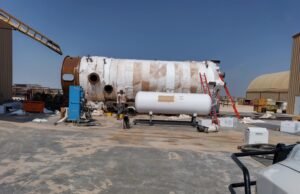
Direct gas fire combustion is a method of performing heat treating where high-velocity gas burners fire directly into or around the equipment being treated. For pressure vessel PWHT, burners fire through the vessel’s available nozzles and manways. The vessel is wrapped in 1-inch 8-lb Kaowool ceramic fiber insulation with a 3-inch overlap at all joints.
That insulated vessel becomes its own furnace — the burners heat the interior, the insulation holds the heat, and the vessel wall conducts temperature uniformly through the full wall thickness. There’s no external chamber. No furnace you drive the vessel to. The vessel stays on your floor, and the heat treating equipment comes to it.
Type K thermocouples are welded directly to the vessel surface using a TAU capacitor discharge spot welder — not clipped, banded, or attached with nuts. That direct contact makes the vessel surface itself the thermocouple junction, producing accurate surface temperature readings. Thermocouple spacing does not exceed 15 feet along the vessel length. All temperature data records continuously on a Chino strip chart recorder from first heat through cool-down. Every channel, every minute, permanently on paper.
GCC Direct Gas Fire Equipment — By the Numbers (as of August 2026)
Up to 8 million BTU — gas train capacity. See how gas train equipment works.
1″ 8-lb Kaowool — ceramic fiber insulation with 3″ overlap
Type K thermocouples — TAU capacitor discharge attachment, max 15′ spacing
Chino AH4000/AH3000 — strip chart recorders, NIST traceable calibration annually
Natural gas or propane — use your facility supply or GCC supplies propane
120+ feet, 600,000 lbs — largest vessel GCC has heat treated on-site
As Featured In
The Fabricator — North America’s Leading Metal Fabricating Publication
James Benefield wrote the August 2026 feature on heat treating large pressure vessels on-site. Four PWHT methods, what happens inside the steel, and the point where a furnace stops being an option.
Read James Benefield’s Feature in The Fabricator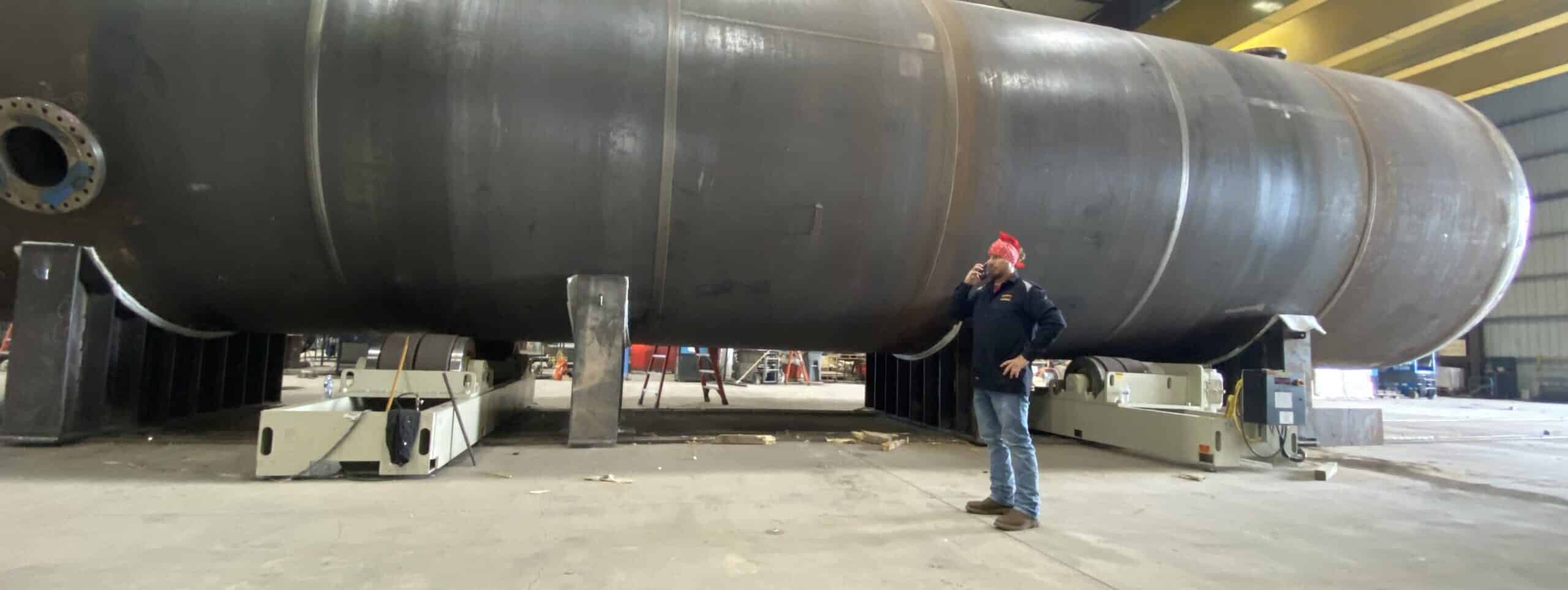
Thermal Processing Magazine — The Industry’s Leading Heat Treating Publication
James Benefield breaks down the execution standards behind every large vessel PWHT job — written execution plan, thermocouple placement, heat cycle calculations, and full documentation.
Read the Technical Article
Why Does Direct Gas Fire Work So Well on Large Pressure Vessels?
High-velocity gas combustion produces both convective and radiant heat transfer. That combination drives heat through thick-walled material faster and more uniformly than methods that rely primarily on radiation. For large, custom-engineered pressure vessels with heavy wall sections, that matters — the code requirement isn’t for the surface to reach temperature, it’s for the full wall cross-section to reach temperature.
The other factor is scale. Gulf Coast Combustion’s gas trains deliver up to 8 million BTU of capacity. Burner count and placement are calculated for each specific vessel based on weight and geometry. A 600,000-pound vessel needs a different burner configuration than a 40,000-pound vessel — and GCC builds that calculation into the execution plan before arriving on site.
The result is a vessel that heats uniformly, meets the temperature differential requirements during soak (no more than 100°F between thermocouples at any point), and cools in a controlled, documented manner from first heat to free-air cool. For a full comparison of on-site vs. furnace methods, see our on-site PWHT vs. furnace breakdown.
Talk to the Owner Directly
James Benefield
Owner, Gulf Coast Combustion — Spring, TX
Call or text — James answers personally. No receptionist. No call queue. No waiting on a callback from someone who wasn’t on the last job.
Need it done fast? Gulf Coast Combustion mobilizes same-day and next-day when the schedule demands it.
When Should You Use Direct Gas Fire vs. Electrical Resistance?
Both methods can produce code-compliant PWHT. The right choice depends on what you’re treating.
Electrical resistance heating uses flexible ceramic pads applied to the exterior of the weld area. It’s the standard method for localized PWHT — pipe spools, nozzle welds, flange faces, and repair welds where only a specific area needs treatment. It’s precise, controllable, and well-suited for smaller work.
For full vessel PWHT on large, thick-walled pressure vessels, direct gas fire is the practical choice. The economics shift significantly at scale. Heating a 200,000-pound vessel with exterior ceramic pads requires a large number of elements, enormous amounts of insulation, and significant electrical infrastructure. Direct gas fire uses the vessel itself as the furnace, requires only the available fuel supply (natural gas or propane), and delivers more BTU energy per operating dollar at that scale.
Gulf Coast Combustion performs both. Over 95% of the vessel PWHT work GCC does is direct gas fire — not because it’s the only method, but because it’s the right method for the work most fabricators bring to us.
Before You Hire
Anyone Can Own the Equipment. Not Everyone Can Cook a Vessel.
The gap between a real specialist and someone with the same gas-fired equipment doesn’t show up on a spec sheet. It shows up on the vessel. Here’s what actually separates the two.
What to Look For in a PWHT ContractorWhat Else Can Direct Gas Fire Combustion Be Used For?
Direct gas fire combustion isn’t limited to pressure vessel PWHT. Gulf Coast Combustion uses the same high-velocity gas systems for two other applications where controlled, uniform heat at scale is critical.
Refractory dry outs. Newly installed refractory lining contains free and chemically bound moisture that must be driven out before the equipment goes into service. Do it too fast and steam pressure builds inside the lining — causing cracking, spalling, and in severe cases, explosive delamination. High-velocity gas combustion delivers precise, controllable heat that follows the manufacturer’s dry out schedule hold stage by hold stage. The same systems GCC uses for vessel PWHT execute refractory dry outs on convection boxes, heater boxes, process heaters, stacks, ducts, and large industrial valves.
Coating and paint cures. Industrial coatings applied to large equipment often require elevated temperature cures to achieve full hardness and adhesion. Direct gas fire provides the controlled heat needed to complete the cure cycle on equipment that can’t be moved to an oven. GCC handles coating cures for fabricators and plant operators alongside its heat treating work. See our full services page for the complete list of applications.
What Does the ASME Heat Cycle Look Like for Pressure Vessel PWHT?
For carbon steel pressure vessels under ASME Section VIII Division 1, GCC’s standard execution parameters are as follows. For a full breakdown of how long a job takes from mobilization to documentation, see how long on-site PWHT takes.
| Parameter | GCC Standard (as of August 2026) |
|---|---|
| Monitoring begins | 300°F — strip chart records from first heat through cool-down |
| Heat-up rate (above 800°F) | 400°F/hr ÷ governing wall thickness, never exceeding 400°F/hr |
| Soak temperature | 1,100°F–1,200°F (GCC standard: 1,150°F ±50°F) |
| Hold time | 1 hour/inch for first 2 inches, then 15 minutes/inch beyond 2 inches |
| Max temperature differential during soak | 100°F between any two thermocouples (250°F permitted during heat-up & cooldown) |
| Cool-down rate | 500°F/hr ÷ governing wall thickness, never exceeding 500°F/hr |
| Free air cooling permitted | Below 800°F |
Every heat cycle is approved by GCC management and quality control before work begins. The execution plan — covering thermocouple placement, burner assignment, heat-up and cool-down rates, and soak parameters — is submitted to the client for approval before the crew arrives on site. For a full breakdown of what the bid covers and why the number is what it is, see why the on-site PWHT bid is the final number.
On-Site PWHT Pricing
See What Your Job Costs — Instantly.
Enter your vessel specs and get a budgetary estimate in seconds — built from GCC’s actual job data. No email required.
Try the Free Calculator →This Is What On-Site PWHT Actually Looks Like
James Benefield, owner of Gulf Coast Combustion, on-site at a live job. Direct gas fire combustion on an 80-foot pressure vessel in Houston, TX — right where it sits.
Frequently Asked Questions
Does direct gas fire PWHT meet ASME code requirements?
Yes. ASME Section VIII Division 1 specifies parameters — heat-up rate, soak temperature, hold time, cool-down rate, and documentation — not the heating method. Direct gas fire combustion fully meets those requirements when executed correctly. Gulf Coast Combustion builds every execution plan to ASME UCS-56 standards with a complete documentation package on every job.
What fuel source does direct gas fire heat treating require?
Natural gas or propane. If your facility has a natural gas supply, GCC can connect directly — this saves the cost of GCC supplying propane on-site. If natural gas isn’t available, GCC arranges propane delivery. Either way, you don’t need to provide electrical infrastructure for the heat treating operation.
When is direct gas fire better than electrical resistance?
For full vessel PWHT on large, thick-walled pressure vessels, direct gas fire is almost always the better choice — it delivers more BTU energy per operating dollar at scale, heats the vessel uniformly from the inside out, and requires no external electrical infrastructure. Electrical resistance is the right method for localized PWHT of specific weld areas — pipe spools, nozzle welds, flange faces, and repair welds where only a targeted zone needs treatment.
What size vessels can be heat treated using direct gas fire?
There is no size limitation. Gulf Coast Combustion has performed direct gas fire PWHT on vessels over 120 feet long and up to 600,000 pounds. Burner count and placement are calculated for each specific vessel. If a vessel can be built and set at your facility, it can be heat treated there using direct gas fire.
For more on how Gulf Coast Combustion executes on-site PWHT from start to finish, see The Fabricator’s Complete Guide to Pressure Vessel PWHT. For common questions answered in plain language, see our PWHT FAQ.
Ready to Get Started?
Talk to James About Your Next Project
Call or text the owner directly at 832-797-3428 — or reach the office at 713-425-3773.