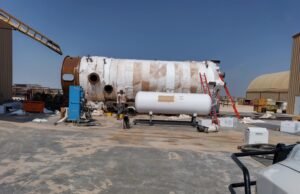

Pipe spools, flange faces, nozzle welds, and seam weld repairs all require post weld heat treatment on a specific area — not a full vessel treatment. Localized PWHT is the right tool for this work, and it’s one of the more common jobs Gulf Coast Combustion performs alongside full vessel heat treating. Here’s how it works, when it applies, and what to expect from the process.
Talk to the Owner Directly
James Benefield
Owner, Gulf Coast Combustion
Call or text — James answers personally. No receptionist. No call queue. No waiting on a callback from someone who wasn’t on the last job.
Common Applications for Localized PWHT
Pipe spools. Circumferential welds on pipe spools fabricated for high-pressure service need stress relief before the spool goes into service. Localized PWHT is standard — the weld area is heated, soaked, and cooled in a controlled manner while the rest of the spool stays at ambient temperature.
Nozzle welds. When a nozzle is added to an existing vessel, the attachment weld needs localized treatment. The vessel may have already been fully PWHT’d — this is a targeted treatment of the new weld only.
Vessel repair welds. In-service vessels requiring seam weld repairs are candidates for localized PWHT when the repair scope and code requirements allow it. Taking a vessel offline for full retreatment isn’t always practical — localized treatment applied correctly to the repair area is often the right answer.
Flange faces and valve bodies. High-pressure flanges and valve bodies with weld repairs frequently require localized PWHT. GCC handles these in the field or in-house at our Spring, TX shop depending on logistics.
Rail cars and refurbished components. Weld repairs on rail cars, pressure tanks, and refurbished industrial components that require PWHT documentation for compliance or inspection purposes.
Localized PWHT — Key Parameters
Method: Electrical resistance — flexible ceramic heating pads
Soak temperature: 1,100°F–1,200°F for carbon steel (GCC standard: 1,150°F ±50°F)
Heated band width: Per ASME Section VIII requirements — minimum coverage of weld plus heat affected zone on both sides
Thermocouples: Type K, attached directly to weld area and band edges
Available on-site at your facility or in-house at GCC’s Spring, TX shop
Documentation: Strip chart recorder trace, thermocouple placement record, calibration certificate — every job
How Localized PWHT Works
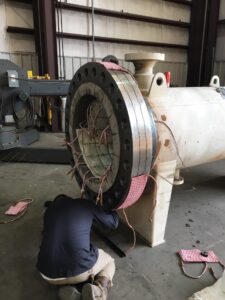
Gulf Coast Combustion uses electrical resistance heating for localized work. Flexible ceramic heating pads are applied directly to the weld area and the required band on each side of the weld centerline. The heated band must extend a specified distance on each side of the weld per ASME Section VIII requirements — enough to ensure the full weld and heat affected zone reach the required temperature, not just the surface.
Insulation is applied over the heated zone and extending beyond it to manage the thermal gradient between the heated area and the surrounding material. This is where execution quality matters. You need the heated zone to reach and hold temperature without creating new thermal stresses in the transition area between hot and cold metal. Getting that thermal gradient right requires experienced operators and correct thermocouple placement — not just wrapping ceramic pads and turning up the power.
Thermocouples are attached directly to the weld area and at specified distances on each side. Temperature is monitored continuously throughout the heat cycle — heat-up, soak, and cool-down — and recorded on a strip chart recorder. The same ASME parameters that govern full vessel PWHT govern localized work: heat-up rate, soak temperature and hold time, maximum temperature differential, and cool-down rate are all defined in a job-specific execution plan.
On-Site or In-House
Localized PWHT is available on-site at your fabrication shop or plant facility, or in-house at GCC’s Spring, TX location. For pipe spool work, bringing spools to GCC’s shop is often the most efficient approach — we can process multiple spools in a single mobilization without the logistics of on-site setup. For nozzle welds and vessel repairs, on-site is usually the only practical option since the vessel is already set in position.
If you have pipe spools, nozzle additions, or repair welds coming up that require PWHT, call early. We can help you confirm the code requirements, determine whether localized or full vessel treatment is appropriate, and schedule the work around your timeline. Same-day quotes are available on most standard jobs.
Related Service
Localized PWHT Services — Gulf Coast Combustion
Pipe spools, flange faces, nozzle welds, and vessel repairs. On-site at your facility or in-house at our Spring, TX shop. Available on short notice.
View Localized PWHT ServicesFrequently Asked Questions
What is the difference between localized PWHT and full vessel PWHT?
Full vessel PWHT heats the entire vessel to the required soak temperature and holds it there for the calculated time. Localized PWHT heats only the weld area and the required band on each side of the weld. The code parameters are the same — soak temperature, hold time, heat-up and cool-down rates. What differs is the scope: localized treatment is applied when only a specific weld or repair area requires stress relief, not the entire vessel.
Can localized PWHT be performed on a vessel that was already fully PWHT’d?
Yes, in many cases. When a nozzle is added or a repair weld is made on a vessel that has already undergone full PWHT, the new weld area may require localized treatment. The code requirements and engineering review for the specific repair will determine whether localized PWHT is acceptable or whether a full retreatment is required. GCC can help you work through that determination.
How quickly can GCC mobilize for localized PWHT?
GCC typically requests 48 hours’ notice for scheduling labor, equipment, and materials. Shorter notice can often be accommodated. For pipe spool work at our Spring, TX shop, turnaround times are generally faster since no mobilization is required. Call James directly at 832-797-3428 for urgent requests.
What documentation do I receive after localized PWHT?
The same documentation package as full vessel work: Heat Treatment Record signed by GCC and the client representative, strip chart recorder trace showing the complete time-temperature history for every thermocouple, NIST traceable calibration certificate for the recorder, and the pre-approved execution plan. Documentation is completed before the crew leaves the job site.
For a full overview of GCC’s localized PWHT services, or to learn more about our full vessel pressure vessel heat treating, visit those pages. For common questions about PWHT answered in plain language, see our PWHT FAQ.
Ready to Get Started?
Talk to James About Your Next Project
Call or text the owner directly at 832-797-3428 — or reach the office at 713-425-3773.