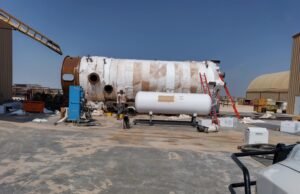

If you fabricate pressure vessels for oil & gas, chemical processing, or petrochemical applications, you already know that post weld heat treatment is code-required on most of what you build. What’s less often discussed is how the vessel type affects the job. A slug catcher and a reactor both require PWHT — but the size, wall thickness, configuration, and access points can be completely different. Gulf Coast Combustion has performed on-site PWHT across the full range of vessel types that show up in these industries. Here’s a breakdown by category.
Upstream and Midstream Vessels
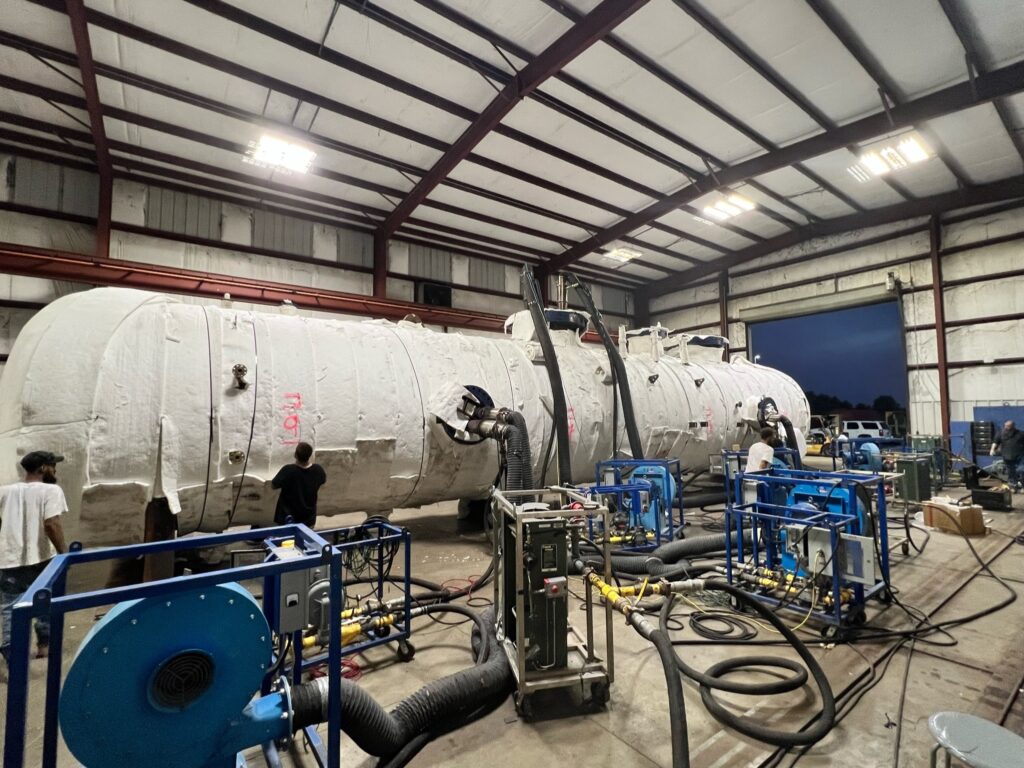
These are the vessels fabricators build most often for pipeline, gathering, and gas processing customers. They tend to run large, and transport to an outside furnace often isn’t practical.
Slug catchers show up regularly in GCC’s work — pipeline liquid separation vessels that can vary significantly in size and wall thickness. Thermocouple placement across the full vessel length is critical to demonstrating uniform temperature distribution.
Amine contactors are among the most common large vessels GCC heat treats. These tall vertical towers remove H₂S and CO₂ from sour gas streams and are a staple of gas treating operations across the Gulf Coast.
Amine regenerators and reflux drums show up alongside contactors in gas treating train fabrication. Typically smaller than the contactor but still subject to full PWHT requirements under ASME Section VIII.
Gas scrubbers, knockout drums, suction drums, and flare knockout drums are workhorses of upstream and midstream facilities. Fabricators often build these in batches for the same project — GCC has treated multiple vessels for the same fabricator across a production run, sometimes in a single mobilization, sometimes across several.
Dehydrators — primarily glycol contact vessels used for gas dehydration — range widely in size. Larger units are typically heat treated on-site.
Separation and Treating Vessels
Two-phase and three-phase separators are among the most frequently fabricated vessels in oil & gas, handling gas, oil, and water separation. Large horizontal separators routinely require on-site PWHT.
Coalescers improve phase separation by combining fine droplets into larger ones — used in both gas/liquid and oil/water applications. Wall thickness and diameter vary based on service conditions.
Flash tanks and flash drums handle rapid pressure reduction in process streams. Wall thickness requirements depend on operating pressure.
Desalters are large horizontal vessels used in crude oil pre-treatment to remove salts before refining. Their size typically makes on-site PWHT the practical choice.
Refinery and Petrochemical Vessels
Reactors are among the most demanding vessels to heat treat — heavy-walled, built to tight specifications for high-pressure, high-temperature service, often with complex internal configurations. Thermocouple placement and documentation are especially critical on reactor jobs.
Absorbers handle mass transfer between gas and liquid phases in chemical processing. Tall, vertical, similar in configuration to amine contactors.
Reflux drums and accumulator vessels are part of distillation and process train fabrication and show up regularly in refinery and petrochemical vessel packages.
LPG bullets and pressure storage vessels are thick-walled by design and frequently require on-site PWHT due to size and operating pressure requirements.
Heat exchangers (shell side) sometimes require PWHT on the shell when wall thickness or material specifications trigger the code requirement.
Why Vessel Type Matters for PWHT Planning
The vessel type tells you a lot before the job starts — likely size range, wall thickness, access point configuration for burner placement, and documentation expectations. Gulf Coast Combustion builds a custom execution plan for every job. Thermocouple placement, burner assignment, heat-up and cool-down rates, hold time, and documentation are all defined before we arrive on site. Every job leaves with a complete documentation package: heat treatment report, strip chart recorder trace, and calibration certificate.
For a full overview of our services, visit gulfcoastcombustion.com/services/. For the technical requirements that govern pressure vessel PWHT, see ASME Section VIII Division 1.
Gulf Coast Combustion performs on-site PWHT across the full range of vessel types listed above, serving fabricators throughout the Gulf Coast and beyond from our base in Spring, TX.
Ready to Get Started?
Talk to James About Your Next Project
Call or text the owner directly at 832-797-3428 — or reach the office at 713-425-3773.