

What the Calculator Actually Does
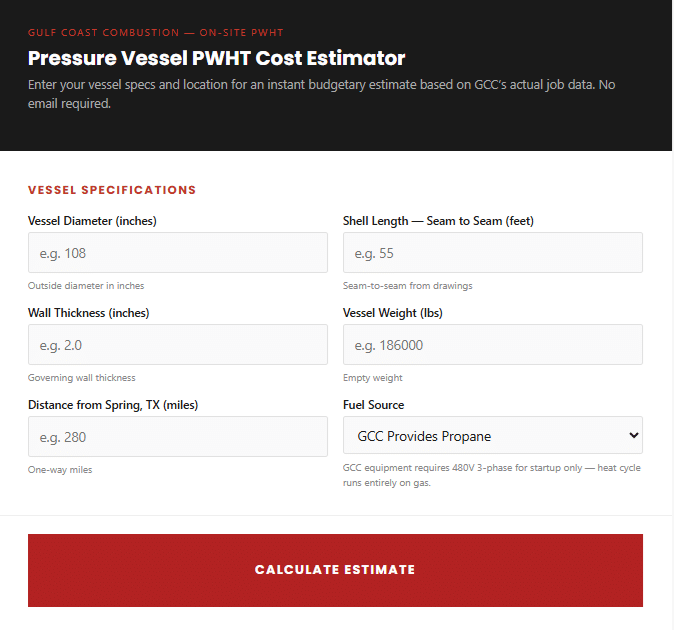
The GCC PWHT Pricing Calculator is built on GCC’s actual job cost structure — the same inputs James uses when he prices a job. Vessel diameter, shell length, wall thickness, weight, distance from Spring, TX, and fuel source. The calculator returns an estimated cost range and a most likely midpoint, along with the number of gas trains required and estimated time on site.
It’s calibrated against real GCC bids. Every non-relationship job tested came back within the expected range. It does not require your email. It does not put you in a sales sequence. You enter your specs, you get a number, you decide what to do with it.
| What’s Included in the Calculator | What Requires a Direct Quote |
|---|---|
| Labor — lead tech and assistant hours | Weekend or short-notice jobs (overtime rates) |
| Equipment — gas trains, recorder, vaporizers | Wall thickness under 1″ or over 3″ |
| Consumables — insulation, TC wire, propane, banding | Spherical vessels or varying diameters |
| Mobilization — round-trip mileage + travel labor | Complex nozzle configurations |
| Per diem and hotel for out-of-area jobs | Non-standard materials |
| Cook time calculated from wall thickness per ASME | Multiple vessels (call for combined quote) |
Try the GCC PWHT Pricing Calculator here.
It’s an estimate, not a guaranteed quote — vessel geometry, site conditions, and access can all affect the final number. But it should get you in the ballpark before you call.
Why Nobody Publishes PWHT Pricing
There’s a real reason heat treating contractors don’t publish pricing. It’s not laziness — it’s a calculated business decision. If a prospect doesn’t know your number, you control the conversation. You find out what they’re willing to pay before you tell them what you charge. The quote becomes a negotiation, not a comparison.
GCC doesn’t operate that way. James quotes straight and the bid holds for six months. There are no fuel surcharge clauses, no “market conditions” adjustments the week before mobilization. The number you get is the number on the invoice.
Publishing a pricing tool is just the logical extension of that. If we’re going to quote straight when you call, we might as well let you run the numbers before you pick up the phone.
The Market Context
If you’ve been pricing out furnace PWHT for a large pressure vessel in the last six months, you’ve noticed something: the transport side of the equation keeps getting more expensive.
Heavy haul rates have climbed. Fuel surcharges are baked into every carrier quote as a variable, not a fixed line item. Oversized load permits, pilot cars, crane rigging at both ends — none of that has gotten cheaper. The furnace quote looks the same. Everything around it doesn’t.
For fabricators running smaller vessels that transport easily, this hasn’t changed the math much. For fabricators building large vessels — the kind that require multi-axle lowboys, oversize permits through multiple states, and cranes at two facilities — the gap between furnace PWHT and on-site PWHT has widened. Not because GCC’s pricing changed. Because the cost of the alternative did.
Why We’re Comfortable Showing You the Number
Pricing isn’t the moat. The ability to execute is.
Anyone can quote a number. Clients tell us directly: GCC is one of the fastest mobilizing heat treating crews they’ve worked with. It’s not something a competitor replicates by knowing what GCC charges for a job. Not many companies can show up with calibrated equipment, a qualified crew, and a written execution plan for a 150,000-pound vessel — and leave you with a complete ASME documentation package before the trucks pull out. That capability took over a decade to build.
If a fabricator looks at the calculator, sees the number, and decides a different contractor is a better fit — that’s the right outcome. GCC’s client relationships are long-term because the work is consistent, not because the pricing was hidden until it was too late to compare.
We’ve been doing this since 2014 — Gulf Coast to anywhere in the U.S. For a full comparison of on-site vs. furnace costs, see our on-site vs. furnace breakdown. See all GCC service areas. And if you want to talk through a specific vessel, call James directly — he’ll give you a straight answer and a confirmed quote fast.
Technical Resource
The Fabricator’s Complete Guide to Pressure Vessel PWHT
Everything you need to know about on-site pressure vessel PWHT — code requirements, execution standards, thermocouple methodology, documentation, and how to evaluate a heat treating contractor.
Read the Complete GuideAs Featured In
Thermal Processing Magazine — The Industry’s Leading Heat Treating Publication
James Benefield wrote the technical article the industry needed someone to write — what on-site direct gas fire PWHT actually requires to get right.
Read the Technical Article
Ready to Get Started?
Talk to James About Your Next Project
Call or text the owner directly at 832-797-3428 — or reach the office at 713-425-3773.