
The Port of Brownsville is at the center of the most significant energy infrastructure buildout in the United States in nearly 50 years. America First Refining, a $3–4 billion, 168,000 barrel-per-day refinery designed to process Permian Basin light shale oil, is moving toward groundbreaking at the Port of Brownsville in 2026 and targeting operations by 2028–2029. Projects of this scale require enormous quantities of custom-engineered pressure vessels, heat exchangers, and process equipment. Every one of those vessels requires code-compliant PWHT before it goes into service.
If you’re building high-pressure, thick-walled pressure vessels and need a mobile heat treating partner who shows up, executes clean, and hands you full documentation before they leave, call our owner James Benefield directly at 832-797-3428. He answers calls and texts personally, including short-notice and emergency jobs.
Essential Reading
The Fabricator’s Complete Guide to Pressure Vessel PWHT
Code requirements, execution standards, thermocouple methodology, documentation, and how to evaluate a heat treating contractor.
Read the GuideTalk to the Owner Directly
Owner, Gulf Coast Combustion
Call or text — James answers personally. No receptionist. No call queue. No waiting on a callback from someone who wasn’t on the last job.
America First Refining at the Port of Brownsville is the first new U.S. oil refinery in nearly 50 years. The facility is designed specifically to handle light, sweet Permian Basin shale oil — technology that many existing Gulf Coast refineries aren’t configured to process. With Reliance Industries as a minority partner purchasing over 80% of output under a 20-year agreement, this project is built for the long term.
The fabrication demand this project generates is substantial. Pressure vessels, heat exchangers, columns, separators, and process equipment built to ASME Section VIII Division 1 standards, all requiring post weld heat treatment before they go into service. The construction window is expected to run through 2028–2029. As fabrication contracts get awarded and construction ramps up, the demand for code-compliant PWHT in this region will be significant.
GCC brings the equipment directly to your facility. Our mobile direct gas fire combustion systems handle vessels of any size, with gas trains running up to 8 million BTU.
Gulf Coast Combustion has been performing on-site pressure vessel PWHT across South Texas since 2014. Brownsville is roughly 5 hours from our Spring, TX shop, a manageable mobilization for a market this active. For a breakdown of PWHT requirements in practice, see our post on PWHT requirements under ASME Section VIII.
No Transport
No oversized load permits. No rigging. No transit risk. Your vessel never leaves your yard.
On-Site QC Witness
Your QC team monitors chart recorder data in real time throughout the entire cycle.
ASME Compliant
Every job executed to ASME Section VIII or your customer-specified WPS and code requirements.
Full Docs Before We Leave
Heat treat record, strip chart trace, calibration certificate, and execution plan, complete before GCC trucks leave your yard.
As Featured In
The Fabricator — North America’s Leading Metal Fabricating Publication
James Benefield wrote the August 2026 feature on heat treating large pressure vessels on-site. Four PWHT methods, what happens inside the steel, and the point where a furnace stops being an option.
Read James Benefield’s Feature in The Fabricator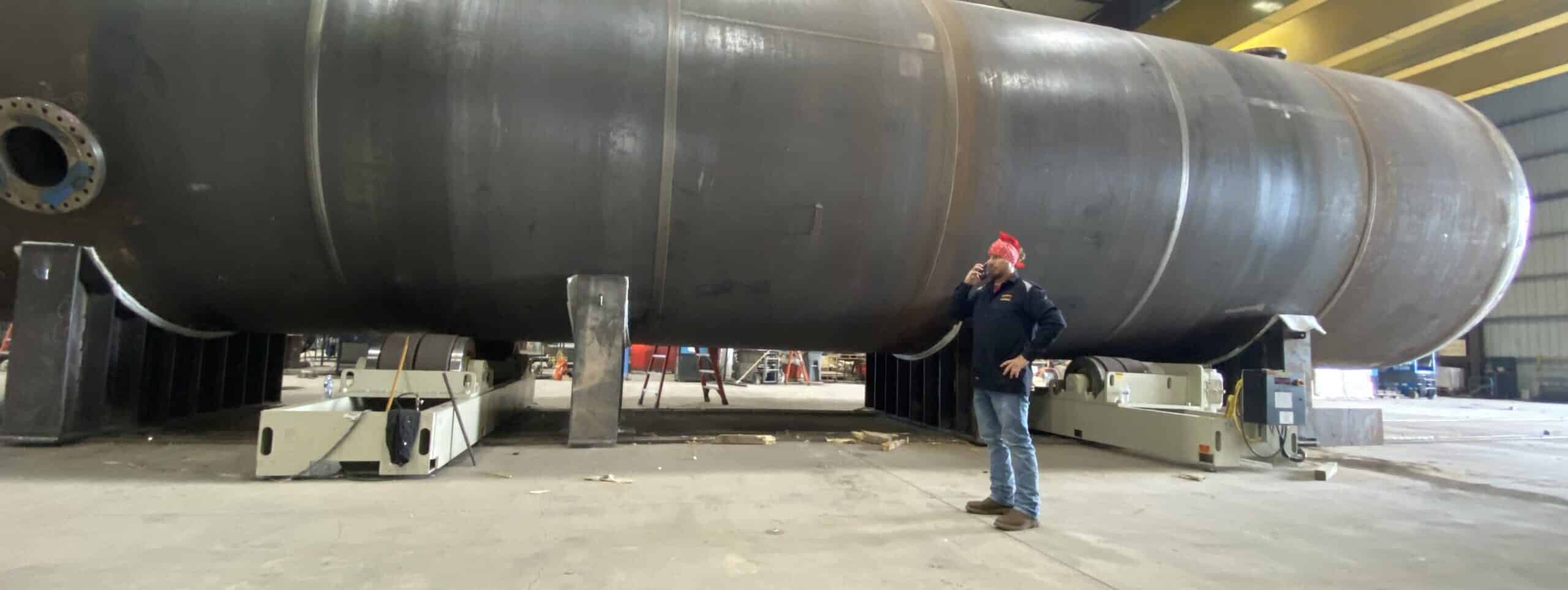
Thermal Processing Magazine — The Industry’s Leading Heat Treating Publication
James Benefield breaks down the execution standards behind every large vessel PWHT job — written execution plan, thermocouple placement, heat cycle calculations, and full documentation.
Read the Technical Article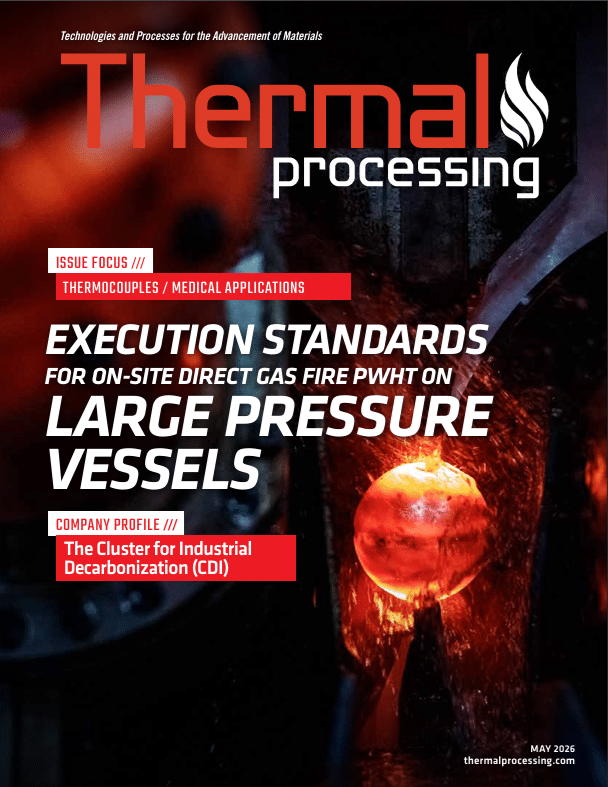
For thick-walled, high-pressure pressure vessels of the kind fabricated for refinery construction and petrochemical operations along the South Texas coast, direct gas fire combustion delivers uniform, controllable heat across large surface areas. Our Type K thermocouples with capacitor discharge attachment and NIST-calibrated Chino recorders monitor and document every phase of the cycle. For more on the method, see what direct gas fire heat treating is and why it matters.
We follow ASME Section VIII parameters on ramp rates, soak temperatures, and hold times on every job. Our standard soak temperature is 1,150°F ±50°F. Heat-up and cool-down rates are calculated by wall thickness. Nothing is guessed, and nothing is left undocumented.
Weighing Your Options
On-Site vs. Off-Site Furnace — The Full Breakdown
Cost, transport risk, size limits, schedule control, and documentation compared side by side for large pressure vessels. For refinery-scale vessels, the math is rarely close.
Read the Full ComparisonPressure vessel PWHT is our primary work, but we also provide a full range of industrial heat treating services across the Gulf Coast and South Texas.
Refractory Dry Outs · Localized PWHT · In-House Furnace · Tank Lining Heat Cure · View All Services →
GCC mobilizes throughout the Brownsville area and surrounding South Texas region, including:
As the America First Refining project develops, fabrication shops across the Rio Grande Valley and South Texas corridor are positioned to capture supply and subcontract work. Those vessels need heat treating. GCC is ready to support that work on-site, on schedule, with full documentation.
Don’t see your area? GCC mobilizes statewide and nationwide. Call us and we’ll make it work.
A 600,000 lb pressure vessel. Wrapped, fired, and fully documented on-site. 72 hours of work in 90 seconds.
This is a vessel over 70 feet long and 600,000 lbs, heat treated on-site using direct gas fire combustion. No furnace. No transport. Full documentation package delivered before GCC left the yard.
Getting a quote from GCC is straightforward. Here’s how it works.
1. Send us your specs
Drawings are ideal, but vessel weight, length, width, and wall thickness get us started. Email james@gulfcoastcombustion.com or call 713-425-3773.
2. We price it out
James reviews your specs personally and turns around a quote fast. No waiting on a sales team.
3. We schedule and mobilize
GCC is available on short notice. If your timeline is tight, tell us up front. We work around fabrication schedules regularly and can mobilize faster than you’d expect.
4. Full documentation before we leave
Every job includes a complete documentation package: heat treat record, strip chart recorder trace, calibration certificate, and written execution plan. Your QC package is complete before GCC trucks leave your yard.
Ready to Get Started?
Talk to James About Your Brownsville / South Texas Project
Call or text the owner directly at 832-797-3428 — or reach the office at 713-425-3773.
Brownsville is roughly 5 hours from our Spring, TX shop. For jobs tied to the Port of Brownsville area or the America First Refining project, we plan mobilization around your fabrication schedule. Call James directly at 832-797-3428 for availability.
Our mobile equipment handles vessels of virtually any size. We have treated vessels over 100′ long and 600,000 lbs on-site. For most large vessels, furnace transport is possible — it’s just not cost effective. Oversized load permits, rigging, transit risk, and furnace scheduling all add up. On-site heat treating eliminates that entire cost category.
Yes, and we encourage it. Your team can monitor chart recorder data in real time throughout the entire cycle.
All the time. We walk first-time clients through the full process before the job starts — thermocouple placement, documentation requirements, what to expect during heat-up and hold. No surprises.
Yes. The Port of Brownsville, Harlingen, Edinburg, McAllen, and the full Rio Grande Valley are within our South Texas service range. As the America First Refining project develops through 2028-2029, GCC is positioned to support fabricators supplying that project and the broader South Texas market.
| Soak Temperature | 1,100°F – 1,200°F (GCC standard: 1,150°F ±50°F) |
| Heat-Up Rate | 400°F/hr ÷ wall thickness — never exceeds 400°F/hr |
| Cool-Down Rate | 500°F/hr ÷ wall thickness — never exceeds 500°F/hr |
| Max Temp Differential | 100°F during soak — monitored across full vessel length |
| Thermocouples | Type K — TAU capacitor discharge attachment |
| Recorders | Chino AH Series — NIST traceable calibration annually |
| Gas Trains | Up to 8 million BTU — direct gas fire combustion |
Based in Spring, TX · Serving Brownsville, South Texas & the Gulf Coast
Ready to Schedule Your Next PWHT Job?
Call or text James directly at 832-797-3428 — or reach the office at 713-425-3773. Email james@gulfcoastcombustion.com.
