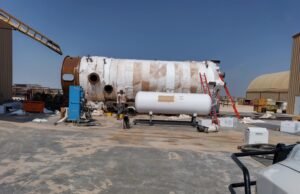

Thermal insulation is a critical component of every on-site pressure vessel heat treating job. In industrial heat treating, the term refers specifically to glass fiber blanket insulation applied directly to a workpiece — creating a thermal barrier that reduces heat loss and maintains the controlled, consistent temperatures required for proper post weld heat treatment (PWHT) on high-pressure, thick-walled pressure vessels built to ASME Section VIII standards.
Without correctly installed insulation, achieving a proper heat soak is impossible. As a result, it is one of the most important elements of any PWHT procedure.
What Is Heat Treating Insulation?
Manufacturers produce blanket type insulation from high-quality spun glass fibers with high tensile strength and resiliency. It comes in a variety of densities and sizes with a maximum temperature rating of 2,300°F (1,260°C) — more than sufficient for the elevated temperatures required during pressure vessel PWHT.
Gulf Coast Combustion uses 1″ thick, 8 lb. density Kaowool Blanket S Insulation on every job. Manufacturers melt recycled glass and spin it into fine strands of wool, forming rolls that GCC uses across pressure vessels, spool piping, flanges, heat exchangers, rail cars, refractory, and furnaces.
How Is Insulation Used in Pressure Vessel Heat Treating?
When performing on-site PWHT on high-pressure, thick-walled pressure vessels, GCC technicians apply insulation on the opposite side of the material or weld being treated. This stops heat loss and ensures an adequate heat soak across the full vessel wall. Code-compliant PWHT under ASME Section VIII Division 1 / UCS-56 requires it.
When wrapped around a heating element such as a Flexible Ceramic Heater or Combustion Gas Burner, the insulation creates an “oven” effect. This still air atmosphere consumes oxygen and reduces iron oxide effects on steel alloys. This controlled environment is essential for achieving uniform, consistent temperatures across custom-engineered pressure vessels during the cook cycle.
GCC technicians install insulation correctly to minimize harmful temperature gradients — the rate and direction at which temperature changes around a specific location. Improper installation creates uneven heat distribution, compromising weld and vessel integrity.
GCC’s experienced, long-tenured crew attaches insulation using banding, iron wire, tape, stud pins, wire rod mesh, and welding pins or rods depending on the application and vessel geometry.
Insulation Maintenance and Disposal
Water does not affect insulation blankets — physical properties are fully restored after drying. However insulation is a consumable material and should be disposed of promptly after each heat treating cycle. The glass fibers begin to degrade after wrapping, attaching, and removing, making reuse inadvisable for code-compliant pressure vessel PWHT jobs.
Safety Precautions
Mishandling insulation can irritate skin, eyes, and respiratory systems with prolonged contact. GCC technicians handle insulation with gloves at all times. Technicians wear safety glasses, long sleeves, and pants to reduce or eliminate irritation. In confined areas with limited air movement, technicians use dust masks or respirators with particle filters at all times.
At Gulf Coast Combustion, safety isn’t a policy — it’s a culture. Our crew operates under a Think Safe, Work Safe commitment on every job, every time.
Insulation is one component of the larger on-site PWHT process. For a full breakdown of how direct gas fire heat treating works: What Is Direct Gas Fire Heat Treating — and Why Does It Matter for High-Pressure Vessels?
Ready to Get Started?
Talk to James About Your Next Project
Call or text the owner directly at 832-797-3428 — or reach the office at 713-425-3773.